
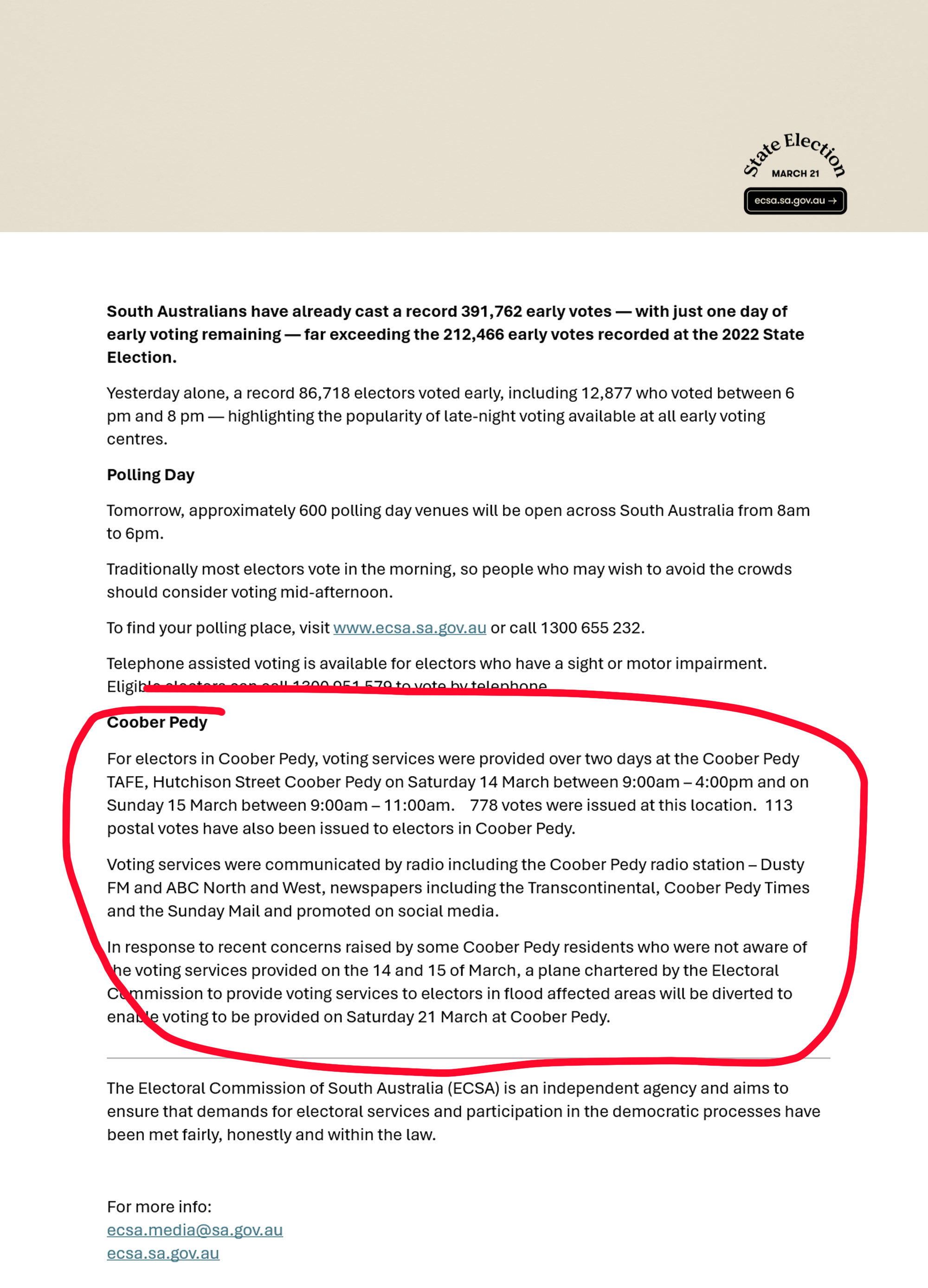
The Electoral Commission of South Australia (ECSA) may believe the matter is settled. For the people of Coober Pedy, it is anything but.
After what can only be described as a profound administrative failure, community pressure forced ECSA to backtrack and reintroduce voting on March 21 — the official polling day — for Coober Pedy. But what was delivered was not a solution. It was a token gesture: just two hours of access.
And yet, even within that narrow window, locals turned up.
That alone dismantles the central claim put forward by the Commission — that the community had been adequately informed and that early voting arrangements were sufficient.
They were not.
The turnout during those two hours proved exactly what residents had been saying all along: many people did not know that the 14th and 15th of March were their only real opportunity to vote. That critical detail — the difference between an option and the only option — was never clearly communicated.
Despite this, ECSA’s official position attempts to shift responsibility. In its media release, the Commission states that voting services were “communicated by radio… newspapers… and promoted on social media.”
But here lies the problem.
We have seen that material.
Nowhere — not in the radio advertisements, not in the print notices — were residents explicitly told that if they missed those early dates, they would lose their chance to vote altogether.
This is not a minor oversight. This is the difference between participation and disenfranchisement.
To suggest otherwise is not just misleading — it is evasive.
Which raises the obvious question: was this confusion accidental, or the result of careless communication dressed up after the fact?
Or, as Pauline Hanson famously put it — “please explain.”
Because the questions do not stop at Coober Pedy.
If ECSA has now acknowledged — even implicitly — that its handling of voting access here was flawed, why was this “fix” not extended to other remote communities?
What about Roxby Downs?
What about other isolated regions across South Australia that were subject to the same early voting model?
Did they receive additional polling access?
Or did Coober Pedy only get a response because its residents were loud enough, organised enough, and persistent enough to force one?
If that is the case, it points to a deeply troubling reality: that electoral fairness in South Australia may depend less on equal treatment and more on who shouts the loudest.
That is not democracy. That is damage control.
Meanwhile, this issue appears to be quietly fading from broader public discussion — something that should concern every South Australian.
Is the Commission under the impression that a last-minute, two-hour polling window resolves the issue?
Does it believe this gesture removes the need to answer for what many are now calling a systemic failure?
Because beyond Coober Pedy, the cracks are visible elsewhere.
In Port Augusta, voters reported being unable to locate polling booths after long-standing venues were changed with little notice. At other locations, polling was interrupted due to technical failures, with booths closing for extended periods.
These are not isolated inconveniences. They are failures in the most fundamental process of a functioning democracy.
Taken together, they paint a picture not of a smooth electoral operation, but of one that struggled under pressure — and then attempted to explain away its shortcomings after the fact.
The people of Coober Pedy are still waiting for answers.
And more broadly, South Australians should be asking whether this election was conducted to a standard that inspires confidence — or one that demands scrutiny.
Because when access to the ballot box becomes uncertain, so too does the legitimacy of the outcome.
The question now is no longer just about Coober Pedy.
It is whether the integrity of the entire election process has been compromised — and whether that warrants something far more serious than a media release.
Perhaps even a return to the polls.
Bush Telegraph Dispatch