
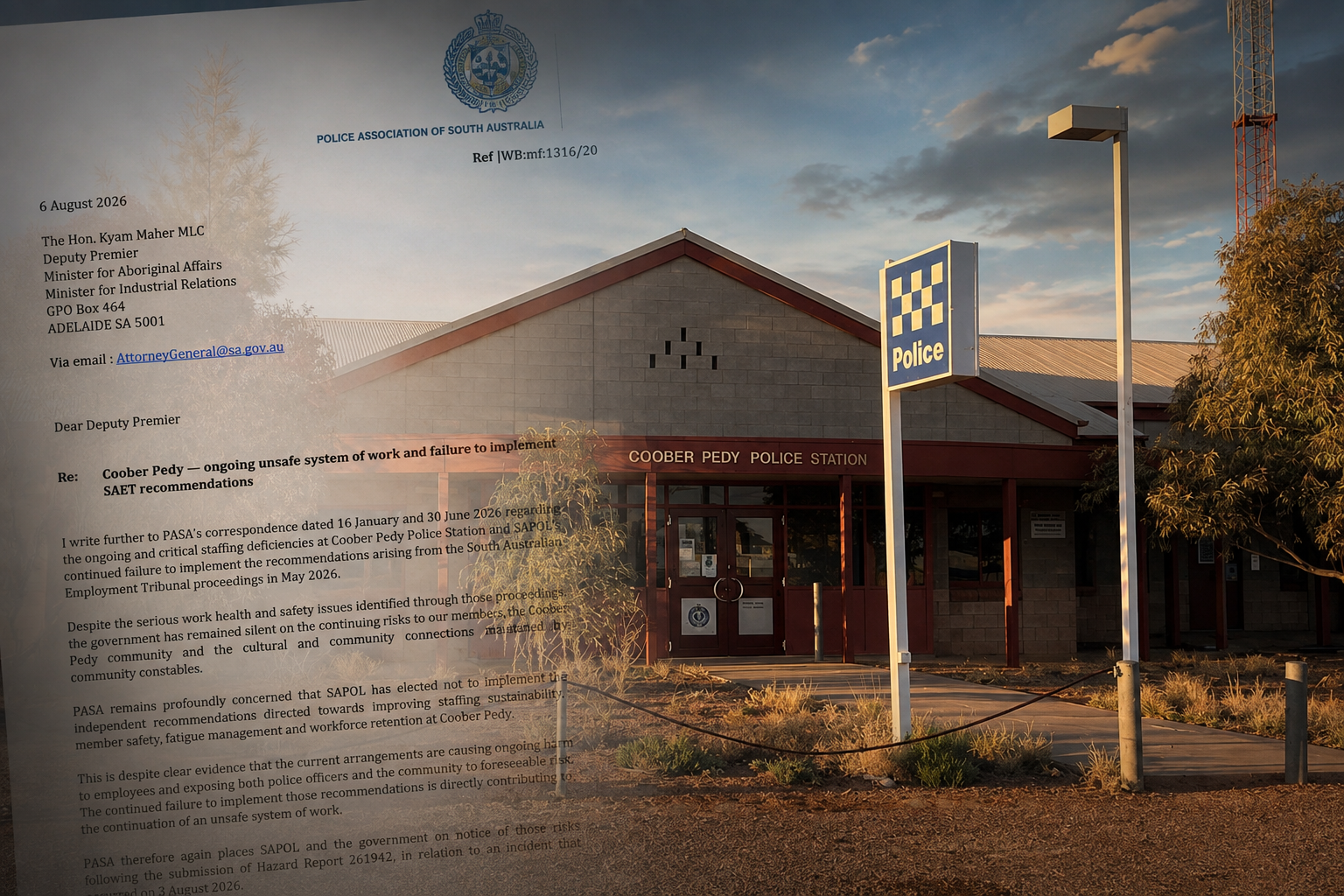
The latest warning from the Police Association of South Australia should concern every Coober Pedy resident — but perhaps not for the reason some headlines might suggest.
Coober Pedy does have crime. We have experienced vehicle thefts, break-ins, property offences and incidents involving young repeat offenders.
But Coober Pedy did not invent youth crime, and portraying what is happening here as some uniquely Coober Pedy phenomenon misses a much bigger story.
Youth offending — particularly serious and repeat offending by a relatively small number of young people — is an issue communities across Australia are wrestling with.
The question Australia needs to be asking is not simply where are these children offending?
It is why are some of our children reaching the point where stealing cars, breaking into homes, dangerous driving and repeatedly breaching bail have become normal behaviour — and why are our systems apparently so ineffective at stopping the cycle?
That is a national conversation.
What is specifically a Coober Pedy issue, however, is whether our police are being given the resources to do their job.
And according to an extraordinary six-page letter sent by Police Association of South Australia president Wade Burns to Deputy Premier Kyam Maher on August 6, the answer is increasingly difficult to argue.
11 Vacancies — Possibly 12 — From 19 Positions
The figures contained in Mr Burns' letter are alarming.
By the end of August, the Coober Pedy Police Station is expected to have 11 vacancies from an establishment of 19 full-time equivalent positions.
A further general duties vacancy is anticipated, potentially taking that figure to 12 vacancies from 19 positions.
And even those numbers, according to the Police Association, make the operational situation look better than it actually is.
The establishment of 19 includes three Community Constable positions and the Senior Sergeant.
Community Constables perform an important specialist role involving cultural advice, community engagement and culturally competent policing. The Senior Sergeant has leadership, governance and management responsibilities.
They cannot simply be counted as four ordinary frontline general duties officers.
As Mr Burns puts it, doing so creates a "misleading impression of the station's operational capacity and masks the true extent of the shortage in deployable sworn police officers."
Four relieving officers are currently assisting under the Help Out Your Mate program, but the Police Association makes an obvious point: temporary relief is not a substitute for permanently filling positions.
The Officers Who Remain Are Carrying the Load
There is another part of this story which deserves considerably more attention.
The police officers currently serving Coober Pedy are still turning up.
They are still answering calls.
They are still arresting offenders.
And, according to their own association, they are doing it while excessive overtime and fatigue take an increasingly serious toll.
The association says the staffing shortage has resulted in excessive overtime, with fatigue contributing to increased sick leave, psychological injury and workers compensation absences.
That creates a vicious cycle.
Fewer officers means more overtime for those who remain. More overtime creates greater fatigue. Greater fatigue contributes to illness and absence. Those absences then place even greater pressure on the officers still standing.
The association says the current arrangement provides "no meaningful operational contingency" and fails to adequately control known fatigue and psychological hazards.
That isn't criticism of our local police.
It is precisely the opposite.
It is recognition that there is a limit to how long dedicated people can be expected to compensate for a system that isn't providing them with enough colleagues.
The Warning Signs Have Already Been There
This situation didn't suddenly appear last week.
The Police Association and SAPOL have already been through proceedings in the South Australian Employment Tribunal over the safety and staffing situation at Coober Pedy.
The tribunal made non-binding recommendations aimed at attracting and retaining officers, including enhanced allowances, rent-free housing with utilities covered, additional leave and other incentives.
Police Commissioner Grant Stevens rejected the recommendations.
His stated reasons included an estimated additional cost of approximately $1 million annually and concerns that implementing the package would create inequity between Coober Pedy and other regional police postings.
Commissioner Stevens said at the time that SAPOL was nevertheless taking "proactive, strategic action" to fill vacancies and support officers in Coober Pedy.
That was in May.
Now, less than three months later, the Police Association says Coober Pedy is heading towards as many as 12 vacancies from an establishment of 19 positions.
That raises a reasonable question.
Is the strategy working?
And perhaps an even more important one:
Is SAPOL's senior leadership listening to the officers who actually have to work under these conditions?
The tribunal recommendations may have been non-binding. The Commissioner was entitled to reject them.
But rejecting a proposed solution does not make the underlying problem disappear.
If SAPOL believed the tribunal's solution was too expensive or inequitable, then it had an obligation to find another solution capable of achieving the same objective.
Judged against the staffing figures now being reported by the Police Association, it is difficult to argue that objective has been achieved.
This Is Bigger Than One Young Offender
Much of the attention surrounding the latest letter will inevitably focus on a young repeat offender currently living in Coober Pedy.
The association describes a disturbing history involving vehicle theft, dangerous driving, property offending and breaches of bail.
It says stolen vehicles have previously been driven towards police.
The association says the youth was recently released after approximately three weeks in custody and granted supervised bail without a curfew. During the bail proceedings, electronic monitoring was raised as an option — but the court was reportedly advised that electronic monitoring was unavailable in Coober Pedy.
According to the Police Association, Youth Justice has no local staff available to fit or monitor the device.
And there lies another part of the problem.
Police arrest offenders.
Police put evidence before the courts.
But police do not write the bail laws. They do not sentence offenders. They do not run Youth Justice. They do not determine whether electronic monitoring services are available in Coober Pedy.
We should be very careful about blaming the officers at the bottom of a system for decisions and deficiencies occurring elsewhere within it.
Nor should the behaviour of one young offender be allowed to define an entire town.
Australia Needs to Ask Why
There is a broader issue here that Australia seems increasingly reluctant to confront beyond the usual political argument over whether penalties should be tougher or bail should be harder to obtain.
Why are some of our kids becoming so disengaged from society that this behaviour becomes acceptable to them in the first place?
Where is the intervention before a child becomes a repeat offender?
Where are the parents, families, schools, youth services and government agencies?
What happens after the first offence? The fifth? The tenth?
And when a child is released back into a community, what meaningful supervision and intervention follows?
Simply cycling young offenders through police cells, courts, detention and back onto the street is not a solution.
Neither is pretending this is exclusively a Coober Pedy problem.
Across Australia, communities are dealing with serious youth offending, stolen vehicles, break-ins and repeat offenders. The circumstances and rates differ enormously between jurisdictions, and national statistics should not be distorted to suggest every community is experiencing the same thing.
But the underlying policy question is national:
What are we doing with the relatively small group of children who repeatedly offend, and why aren't our interventions stopping them?
That conversation needs to happen.
Meanwhile, Coober Pedy Needs Police
Whatever the answers to Australia's youth crime problem ultimately prove to be, Coober Pedy police still have to respond tonight.
And tomorrow night.
And the night after that.
They cannot do that indefinitely through goodwill, overtime and temporary relieving officers.
Mr Burns' letter says the problems have been raised through hazard reports, workplace consultation, industrial proceedings, independent review and direct reporting by police members.
In other words, senior authorities cannot reasonably claim they haven't been warned.
The association says the consequences now include fatigue, psychological injury, workers compensation absences, weakened Community Constable relationships and compromised community safety.
Its final warning could hardly be clearer.
Without urgent intervention, the association says there is a risk that the known hazards could culminate in a "preventable tragedy affecting either a police officer or a member of the community."
Nobody should want to discover whether that warning was justified.
Support the Police Who Are Here
Coober Pedy should not be portrayed as a town overrun by crime.
Thousands of tourists visit our community. Families live here, businesses operate here and ordinary life continues every day without incident.
But defending our town's reputation does not require pretending there isn't a policing problem.
There clearly is.
The distinction is important.
Our police officers are not failing Coober Pedy. The danger is that the system above them is failing both them and us.
Commissioner Stevens rejected the tribunal's proposed solution.
That was his decision to make.
But if the Commissioner believes there is a better way to adequately staff Coober Pedy, the time has surely come to demonstrate what that better way is.
Because according to the people representing the officers actually doing the job, the shortage is getting worse.
Our local police deserve enough colleagues to do their jobs safely.
Our Community Constables deserve to perform the specialist roles they were employed to perform rather than being used to plug holes elsewhere.
Our community deserves a properly resourced police service.
And our children — here and throughout Australia — deserve something better than a system that appears capable of repeatedly processing them after they offend but far less capable of preventing them from returning.
Those are two different problems.
Australia needs to confront one.
SAPOL's leadership needs to fix the other.
Bush Telegraph Dispatch