
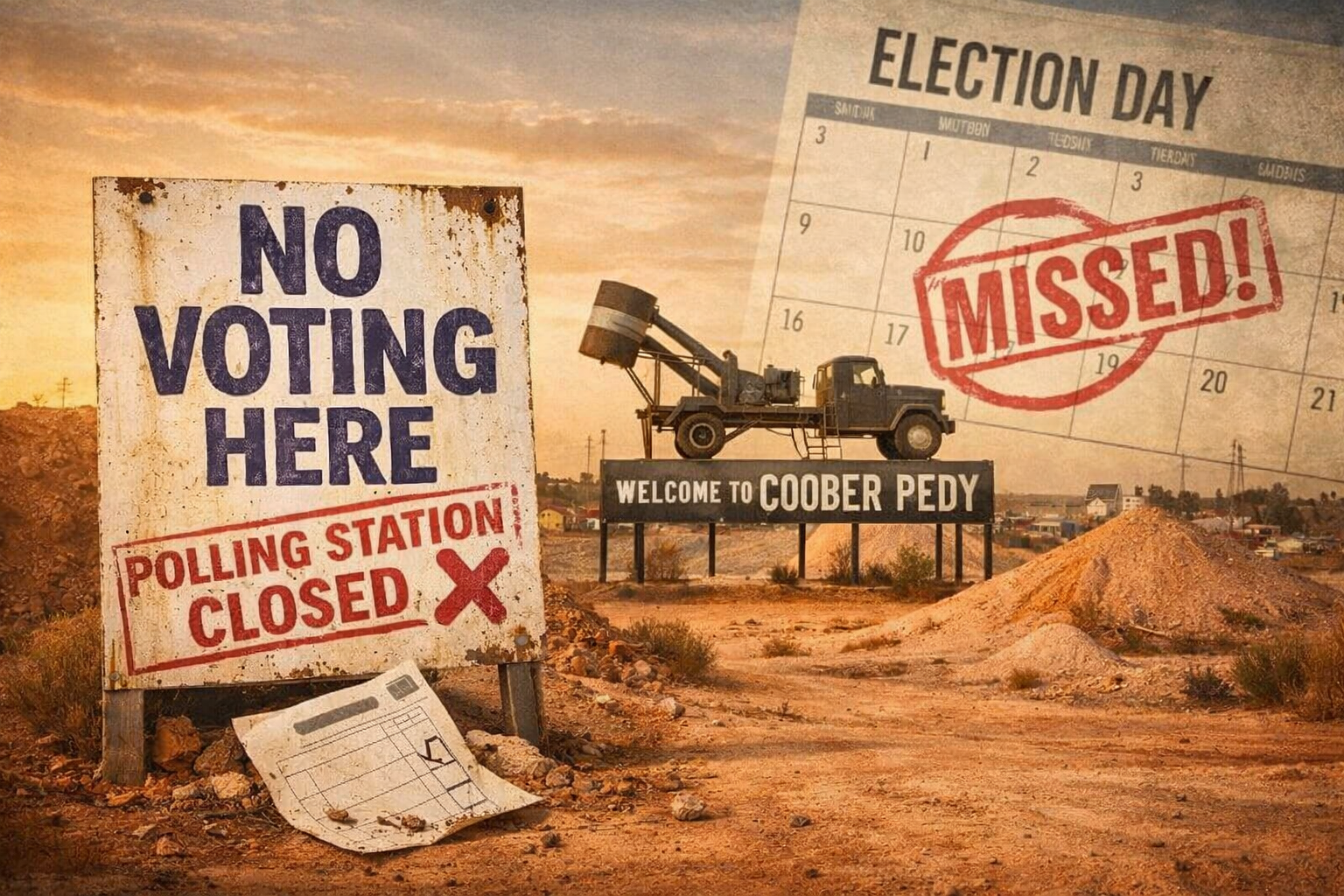
New figures released today by the ABC News have confirmed what many in Coober Pedy already knew — a significant portion of the town was shut out of the democratic process.
More than 30 per cent of enrolled voters in Coober Pedy did not cast a ballot in the recent South Australian state election, equating to over 250 people who missed their chance to vote.
This was not a marginal oversight. It was a systemic failure.
The decision by the Electoral Commission of South Australia to remove the election day polling booth, something the town has always had, left residents relying on limited pre-poll opportunities and last-minute alternatives that many simply did not know about.
Our community raised the alarm early. We pushed. We made noise. And eventually, ECSA responded.
That response came in the form of a fly-in voting service on election day. It resulted in just over 90 additional votes being cast.
Those votes matter. They prove the point.
They prove that people were willing and ready to vote if given the opportunity. They prove that access, not apathy, was the issue.
But even with that late intervention, more than 200 people in this town still missed out.
That is not a communication success. That is a failure that no amount of spin can cover.
ECSA continues to maintain that the changes were adequately communicated through radio, newspapers and online platforms.
Yet on the ground, a different story is being told.
We have the print media. We have the radio logs. We have the lived experience of locals who turned up on election day expecting a polling booth, as there has always been, only to find nothing there.
No signage that reached them in time. No clear messaging that cut through. No meaningful effort to ensure a remote community understood a major change to a fundamental democratic process.
Even those who tried to engage with the system on the day reported being unable to get through to electoral assistance lines.
The numbers now confirm what the community has been saying all along.
This was not an isolated inconvenience. It was a breakdown that left hundreds without a voice.
The fact that Coober Pedy only received a partial remedy, and only after sustained pressure, raises further questions. Were other remote communities treated the same way? Or did this town only receive attention because it refused to stay quiet?
The Electoral Commission may point to procedures, policies and advertising channels. But the outcome is what matters.
More than one in three eligible voters in this town did not vote.
That is the result.
That is the reality.
And until the Electoral Commission addresses not just the numbers, but the reasons behind them, this issue is far from over.
Bush Telegraph Dispatch