
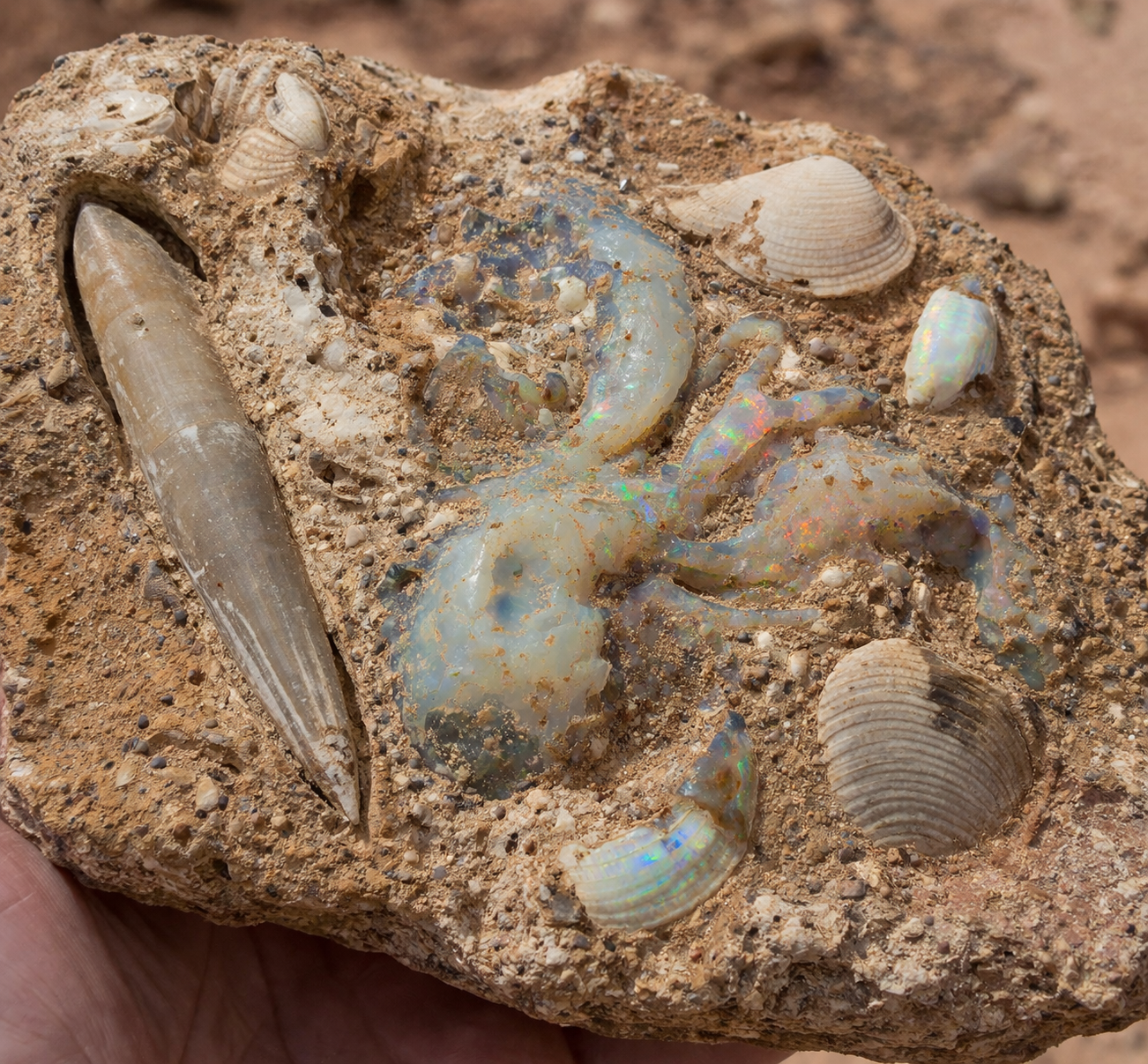
A remarkable discovery in Coober Pedy’s famed opal fields has sent shockwaves through both the mining and scientific communities, with what is being described as the world’s first confirmed opalised octopus unearthed earlier this week.
The specimen was recovered from a private claim in the well-known 17 Mile field, an area already recognised for its abundance of marine fossils dating back to the ancient inland Eromanga Sea. The find was made by local miner Marek Kovács, who initially believed he had uncovered a cluster of shell fossils embedded within a hardened rock pool formation.
“Once I started washing it back, I could see symmetry that didn’t match anything I’d found before,” Kovács said. “Then the tentacle shapes became clear. I knew straight away this was something different.”
The specimen appears to show a small octopus-like creature preserved in opal, surrounded by what experts have identified as fossilised shells and belemnites — further supporting the theory that the formation represents a shallow marine environment from the Cretaceous period.
Early analysis has been conducted in collaboration with researchers from the University of Adelaide, with leading palaeontologist Professor Elena Petrovic describing the find as “extraordinary.”
“If confirmed, this would represent a completely unique preservation of soft-bodied marine life in opal,” Professor Petrovic said. “Octopuses are notoriously difficult to fossilise due to the absence of hard skeletal structures. To see one preserved in opal, with this level of apparent detail, is unprecedented.”
The discovery has reignited long-standing claims within the Coober Pedy community that such specimens may exist. For years, one local miner has insisted that opalised octopus fossils could be found in the region, though these claims have largely been dismissed — until now.
“This changes the conversation,” Professor Petrovic added. “We may need to reconsider what is possible in terms of fossilisation within opal fields, particularly in environments linked to the Eromanga Sea.”
The specimen is expected to undergo further testing, including high-resolution imaging and compositional analysis, to confirm its biological origin. If verified, it could significantly expand scientific understanding of both opal formation and marine life preservation during the Cretaceous era.
Meanwhile, interest in the 17 Mile field has surged overnight, with miners hopeful that this could mark the beginning of an entirely new category of opal discovery.
Local sources report that several claims in the area have already seen renewed activity, as word of the find continues to spread.
Bush Telegraph Dispatch