
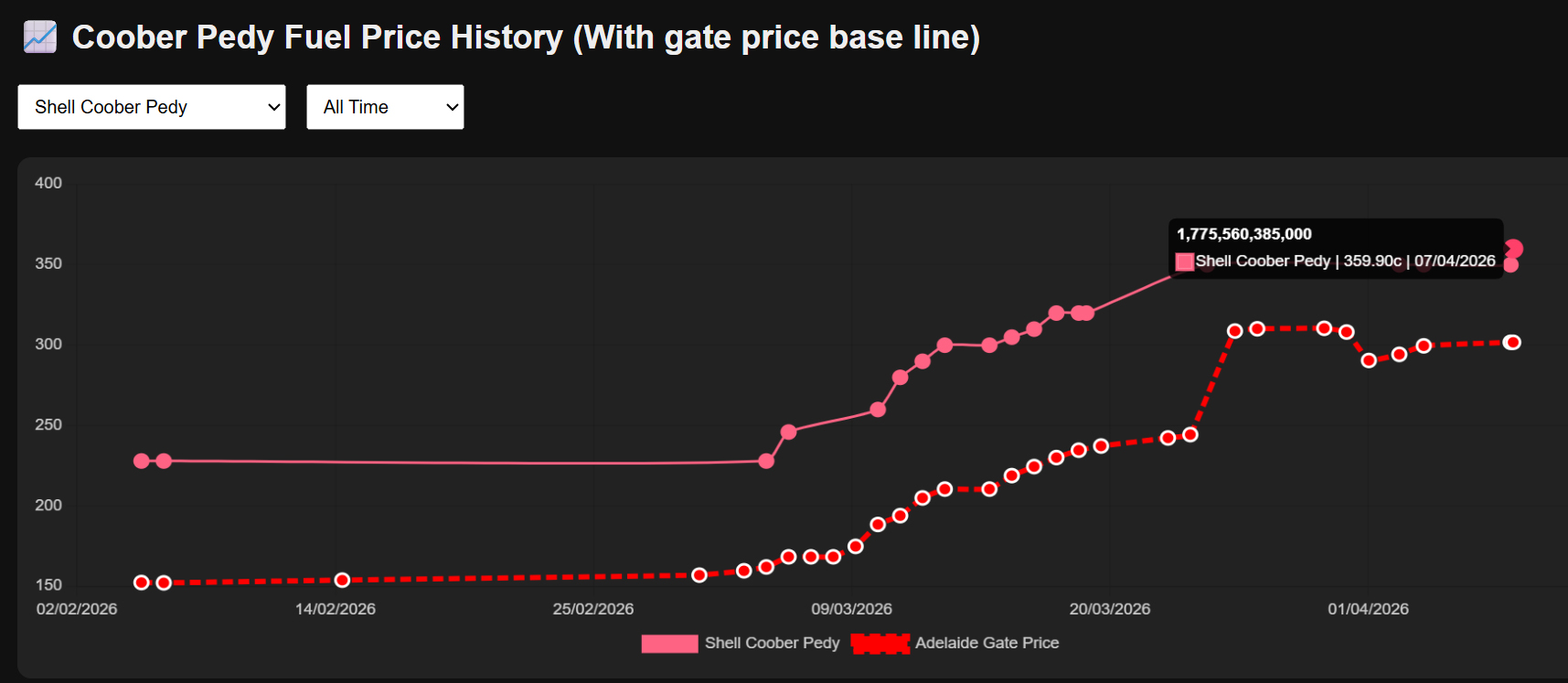
The Federal Government’s decision to halve the fuel excise was meant to provide immediate relief at the bowser. From 1 April 2026, the excise on petrol and diesel was reduced by 26.3 cents per litre for three months, bringing it down from 52.6 cpl to 20.6 cpl. On paper, that should have shaved nearly $19 off the cost of filling a standard 65-litre tank.
But on the ground, that relief has failed to materialise.
Instead of dropping, fuel prices in Coober Pedy have continued their relentless climb, with motorists today hit by yet another 10 cent increase. Even more concerning is the now-familiar pattern — prices rising in near-perfect lockstep across providers, leaving locals questioning whether the intended savings have simply been absorbed by distributors.
From the outset, there were warnings that fuel companies might not pass on the full benefit of the excise cut. Those warnings now appear well founded. Rather than easing cost-of-living pressure, the measure risks becoming little more than a subsidy for an industry already under scrutiny.
The justification being pushed centres around global instability, particularly tensions involving Iran and the Strait of Hormuz. But that narrative is beginning to wear thin. Only around 20 percent of the world’s oil supply is affected by disruptions in that region, and even then, reports suggest Iran continues to allow allied shipments to pass through the strait.
So why are prices behaving as though global supply has been crippled?
Locals are asking a simple question — if the government handed down a 26 cent reduction, why are prices still rising? And more importantly, where is that money going?
The Australian Competition and Consumer Commission has been granted stronger powers and clearer expectations around monitoring fuel pricing behaviour. Yet here we are again, watching prices climb while promised relief disappears before it ever reaches consumers.
For many in regional communities like Coober Pedy, enough is enough. Fuel is not a luxury out here — it is essential. Every increase hits harder, every unexplained jump fuels frustration, and every missed opportunity for relief deepens distrust.
There are serious questions that need answering, and quickly. If the system is working as intended, it should be visible at the pump. Right now, it isn’t.
Bush Telegraph Dispatch