
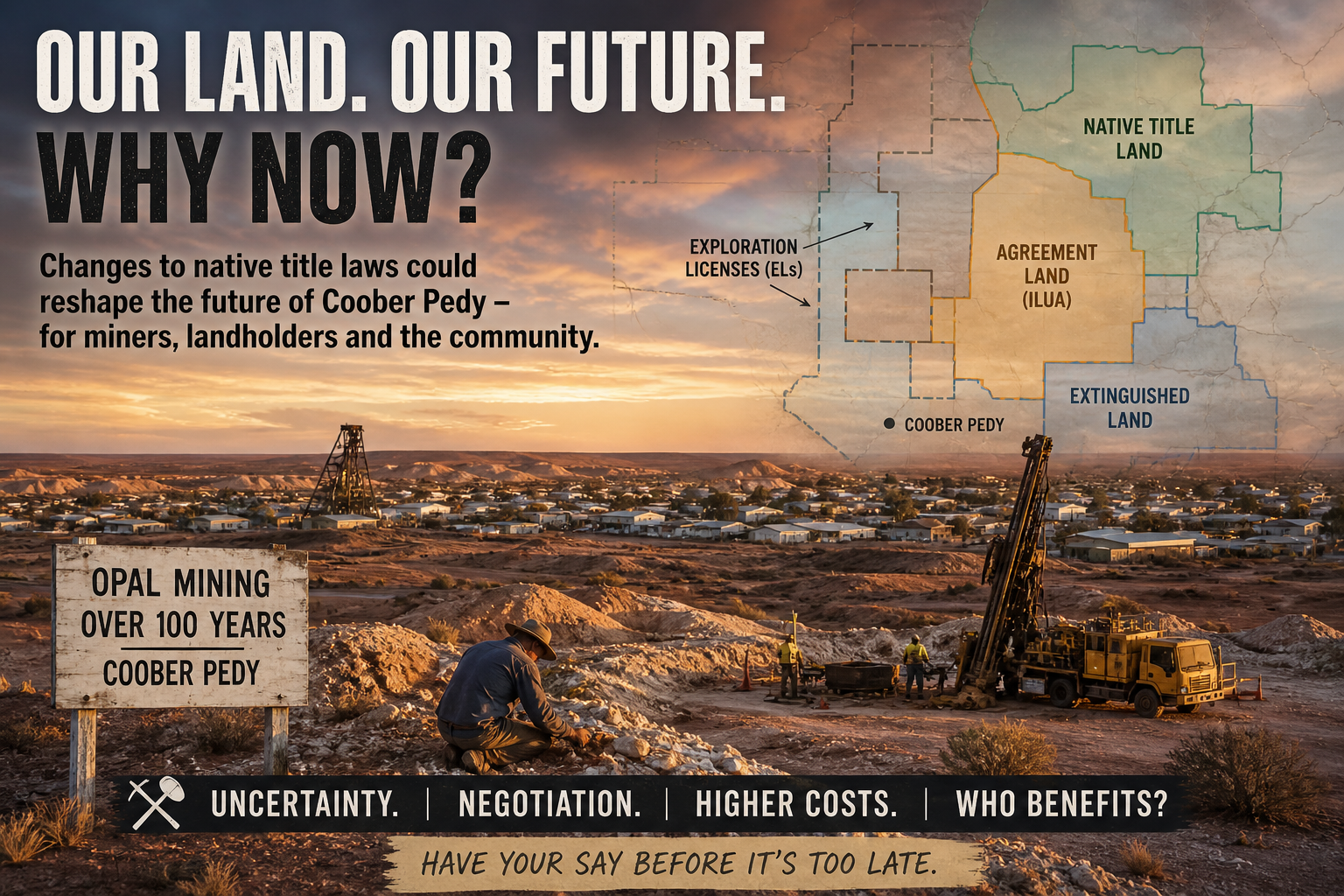
Coober Pedy has always been a town built on grit, independence, and a unique relationship with the land. For over a century, opal miners, pastoralists, and local families have worked this ground under a system that, while imperfect, provided one critical thing: certainty.
That certainty may now be changing.
A new application before the courts seeks to revise native title determinations across the region. On paper, the changes are described as a move toward clearer mapping and negotiated agreements. In reality, they represent a fundamental shift in how land access and control may be decided in the future.
For miners and landholders, the concern is not immediate shutdown. It is something more subtle, and potentially more serious. The rules are changing.
Under the proposed revisions, long-standing assumptions around land use may no longer apply. Areas that were previously treated as exclusively controlled due to use or improvement may now fall under overlapping interests. Access to land may depend less on history and more on formal agreements.
That raises a simple but important question.
Why now?
Opal mining has existed in Coober Pedy for more than 100 years. Generations have worked these fields, often under harsh conditions, building not just an industry but an identity. If the system has functioned for this long, what has suddenly changed to justify such a major shift?
One possible answer lies in what is happening around us.
In recent years, there has been a noticeable increase in large-scale exploration activity in the region. Exploration licences have been granted across areas historically associated with small-scale opal mining. At the same time, new mining activity has begun to the west of town, in ground traditionally considered part of the Olympic Field.
This raises another question.
Are we seeing the groundwork being laid for a different kind of mining future?
Large mining companies operate very differently to local miners. They have the resources to navigate complex legal frameworks, negotiate agreements, and absorb delays. They also tend to work closely with governments and, increasingly, with traditional owner groups through formal partnerships.
If land access becomes dependent on negotiated agreements rather than historical use, who is best positioned to succeed in that environment?
It is not hard to see how a system built on negotiation and legal clarity could favour those with the deepest pockets and the strongest legal teams.
That is where community concern begins to shift into speculation.
Some locals are asking whether these changes could effectively pave the way for large-scale mining operations, while gradually squeezing out small independent miners and even impacting pastoral leaseholders. If traditional rights, exploration interests, and government policy begin to align, the result could be a very different landscape from the one Coober Pedy was built on.
To be clear, this is not a claim. It is a concern.
But it is a concern grounded in observable trends.
We have seen other opal fields across Australia face shutdowns, prolonged delays, or heavy restrictions when land rights, administrative processes, and regulatory changes collide. Once uncertainty enters the system, small operators are often the first to feel the pressure.
There is also the financial reality.
Recent changes at the federal level mean that landholders and miners responding to native title matters may now need to fund their own legal representation. For many individuals and small businesses, that alone could be enough to limit their ability to participate in decisions that directly affect their future.
So again, the question stands.
Why now?
Is this simply a legal evolution following recent High Court decisions?
Or is it part of a broader shift in how land in remote Australia is being managed, valued, and ultimately controlled?
For Coober Pedy, the stakes are high.
This is not just about legal definitions or mapping boundaries. It is about who gets to access the land, who gets to work it, and who benefits from what lies beneath it.
The community has been given a limited window to respond before decisions move forward. Whether you are a miner, a pastoralist, a business owner, or simply someone who calls this place home, the outcome of this process may shape the future of the town for decades to come.
If there is one thing history has shown, it is that once control of land shifts, it rarely shifts back.
And that is why people are asking questions.
Not out of opposition, but out of a desire to understand what comes next.
Because in Coober Pedy, the land has always been more than just ground.
It is the foundation of everything.
Bush Telegraph Dispatch