
An Early Investigation Into the Quiet, Troubled Future of Australia’s Opal Fields
Australia’s opal industry has survived droughts, depressions, and the tumbleweed indifference of successive governments. But now, in 2025, a new threat appears to be emerging — not from nature, but from policy, geopolitics, and a stealthy re-shaping of outback land access.
Across the country, opal fields — once the backbone of remote towns — are being quietly restricted, paused, or shut down entirely. And the timing of those closures is beginning to look… suspicious.
This article is not an accusation. It is an invitation for readers, miners, and researchers to look closer — because something isn’t adding up.
The Lambina Mystery — Closed, But Nobody Will Say Why
With minimal information, it is difficult for me to speculate what happened here. On line research would indicate that the Lambina opal field effectively closed around 2014 when its ILUA agreement came to an end. But unlike most major land-use shifts in SA, no clear public record explains what happened next.
Miners say one day they could peg, and the next day they couldn’t.
If true, Lambina would be the first in a series of significant opal areas slowly choked off from access.
The Mintabie Shutdown — A Story That Never Made Sense
In 2019, Mintabie — once a thriving opal town — was shut down and residents forcibly evicted.
The stated reason?
“Criminal activity endangering APY residents.”
A strange justification, considering:
- There was little policing done to address the problem.
- Drug and alcohol runners travel from Alice Springs into APY lands daily… and no one has suggested shutting down Alice Springs.
Within months of Mintabie’s closure, a new set of Petroleum Exploration Licences (PELs) began appearing across the Officer Basin.
A coincidence?
Maybe. Maybe not.
White Cliffs — A Town Stuck in Government Limbo
The opal miners of White Cliffs (NSW) have been waiting years for the Governor to sign off on new access arrangements. Their ILUA issues were resolved long ago, but mining still cannot resume.
Why?
No one seems willing to explain the delay.
Is the Government stalling?
And if so, for whose benefit?
The Geological Elephant in the Room: Oil, Rare Earths, and Net Zero
Here is what is factual:
- The Great Artesian Basin contains some of the largest shale oil reserves in the world.
- Shale oil originates from organic matter left over from the ancient inland sea .
- Australia’s major opal fields — Mintabie, Coober Pedy, Lambina, White Cliffs — all sit on or near fossil-rich basin structures
Stack on top of this:
- The Gawler Craton is one of the richest geological provinces on Earth for copper, gold, uranium, and rare earths.
- Demand for these minerals has exploded due to the push for electric vehicles, batteries, and net-zero transition.
Suddenly, those “remote dusty opal fields” don’t look so unimportant anymore.
They look like strategic assets.
The Coober Pedy Question — Nobody Is Talking About the New Els
If you live in Coober Pedy, ask yourself:
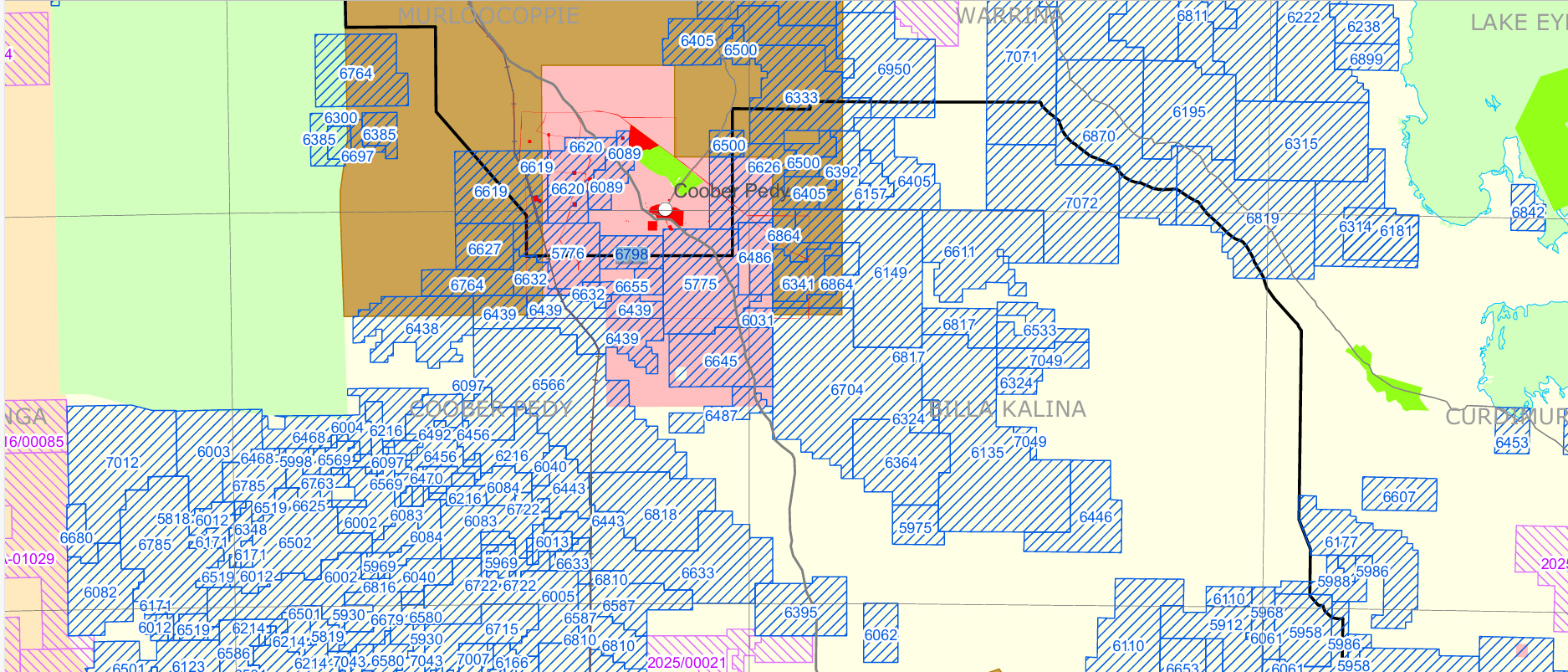
Have you noticed the explosion of Exploration Licences (ELs) around the town?
Many reach deep into traditional opal mining areas. Several lie directly over PSPP zones.
By law, these licences must be publicly transparent.
In practice, the data is almost impossible to find.
This author had to dive through ASX filings to uncover details the SA Government doesn’t make easily available — or in some cases, doesn’t list at all.
Example:
EL 6089 — Golden Cross Resources
Golden Cross is openly targeting Copper–Gold–Rare Earths (as their annual report states).
But their exploration approval has stalled due to:
“issues related to access to the Woomera Area”
— Golden Cross ASX report
Why would Woomera Defence restrictions apply?
Consider this:
Three of Golden Cross's four directors have deep links to China/Hong Kong corporate networks.
This doesn’t prove any wrongdoing.
But it does raise eyebrow-worthy questions about Defence sensitivity, political caution, and why approvals are quietly withheld.
Are Opal Fields Being Squeezed Out to Clear the Way for Mineral Giants?
This hypothetical scenario begins to form:
1. Opal fields — small-scale, independent, unregulated.
2. Mineral & petroleum exploration — high-stakes, high-value, strategically significant.
3. Government actions — opaque restrictions on opal fields; far less transparency on new ELs.
4. Foreign-linked resource companies gaining interest in the region.
5. Defence interference when exploration overlaps Woomera Prohibited Area.
If a conspiracy theorist wanted ammunition, they wouldn’t need to invent anything.
The pattern itself is suspicious enough.
The Long Memory of Coober Pedy Miners
Some locals may recall how “helpful” and “friendly” certain resource companies have been toward opal miners lately.
Is this goodwill?
Or early relationship-building for something much bigger?
After all, BHP hasn’t made a habit of bonding with opal miners before.
And Let’s Not Forget…
The South Australian Labor Government quietly approved Santos and Beach Energy to inject liquified CO₂ into the Great Artesian Basin before the public even knew the project had begun.
Secrecy is becoming standard practice.
So why would exploration licences be treated any differently?
Conclusion: This Isn't a Claim — It's a Call for Vigilance
Every point above can be investigated further. Every question raised is legitimate.
What we need now is:
- miners
- journalists
- geologists
- local councils
- and concerned citizens
…to start digging — not for opal, but for answers.
Because if Australia is quietly phasing out opal mining in favour of oil, gas, copper and rare earth exploration, then the nation deserves to know.
Picture: Current Exploration Licenses (Pink shading indicates opal field).