
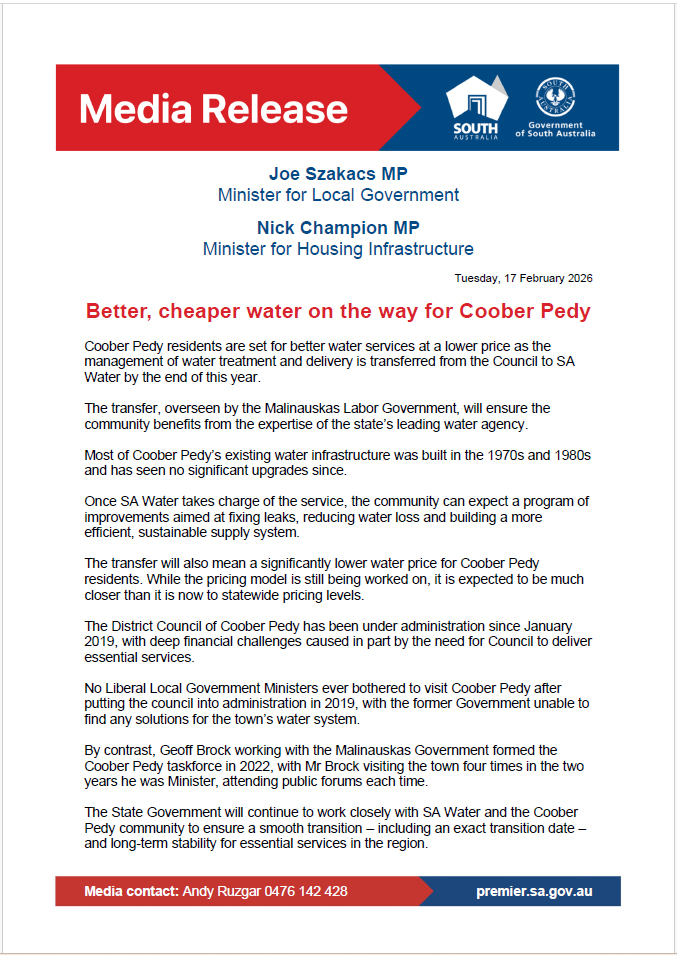
In a media release issued Tuesday, Ministers Joe Szakacs and Nick Champion announced that management of water treatment and delivery in Coober Pedy will be transferred to SA Water “by the end of this year.”
For a town that has battled unreliable infrastructure, ageing systems and crippling costs for decades, the announcement is significant.
But as with many things in Coober Pedy’s political history, the devil is in the detail… and the timing.
A Long Time Coming
Much of Coober Pedy’s water infrastructure was built in the 1970s and 1980s and has seen little meaningful upgrade since. Leaks, inefficiencies and high costs have been persistent complaints from residents and business owners alike.
The idea of transferring control to SA Water is not new. It has been raised repeatedly over the years, particularly during the town’s prolonged period under administration since 2019. Administrators were acutely aware of the problems and made persistent efforts to have the town’s water infrastructure privatised or taken over.
For many locals, state intervention in essential services has felt inevitable — even necessary — given the council’s well-documented financial struggles.
If SA Water does assume control, residents can reasonably expect:
- Improved maintenance and infrastructure investment
- Reduced water loss
- Greater operational efficiency
- Pricing closer to statewide norms
That last point alone could bring relief to households and businesses already stretched by cost-of-living pressures.
Credit Where It’s Due
Minister Geoff Brock, who has had a long association with Coober Pedy and previously visited multiple times while Local Government Minister, deserves recognition if this agreement has genuinely been negotiated and secured.
If he has managed to bring SA Water to the table and broker a workable transition, that is no small feat. For a town often overlooked in metropolitan decision-making, meaningful engagement matters.
But that’s where the cautious optimism begins.
No Date. No Model. No Guarantees.
The release states the transfer will occur “by the end of this year.”
There is no exact handover date.
There is no confirmed pricing structure.
There is no publicly released transition plan.
And this announcement arrives on the eve of a state election.
That timing will not be lost on residents who have seen promises made before, sometimes loudly, sometimes confidently — only to watch them fade after ballots are counted.
Is this a genuine structural reform that will finally stabilise essential services in one of South Australia’s most unique communities?
Or is it a carefully timed reassurance designed to soften political ground in a regional electorate?
A Town on Its Knees
It is no exaggeration to say Coober Pedy has been struggling for years.
Water has not been the only issue. Policing shortages, hospital pressures, council administration, infrastructure decay. The list is long and well documented.
The town has not just been asking politely for reform. It has been pleading.
Residents have endured uncertainty and instability long before any election promise was dangled.
If this move represents real structural change and backed by funding, engineering expertise and a firm transition timeline… it could mark a turning point.
If it is simply an announcement without follow-through, it risks deepening the cynicism many regional communities already feel toward Adelaide.
Hope — With Eyes Open
There is room here for cautious hope.
State-level management of essential services makes practical sense. SA Water has the scale, expertise and financial capacity that a small outback council simply does not.
But Coober Pedy residents have learned the hard way to listen carefully to what is not said as much as what is.
Until a formal agreement is signed, a handover date locked in, and pricing confirmed, this remains a promise — not a transformation.
The town will be watching closely.
And this time, it will remember.