
Residents of Coober Pedy have long accepted that living in one of Australia’s most remote towns comes with higher costs. Freight, logistics, and isolation all play their part. But newly analysed fuel data is now raising serious questions about just how much is reasonable — and whether locals are paying far more than they should.
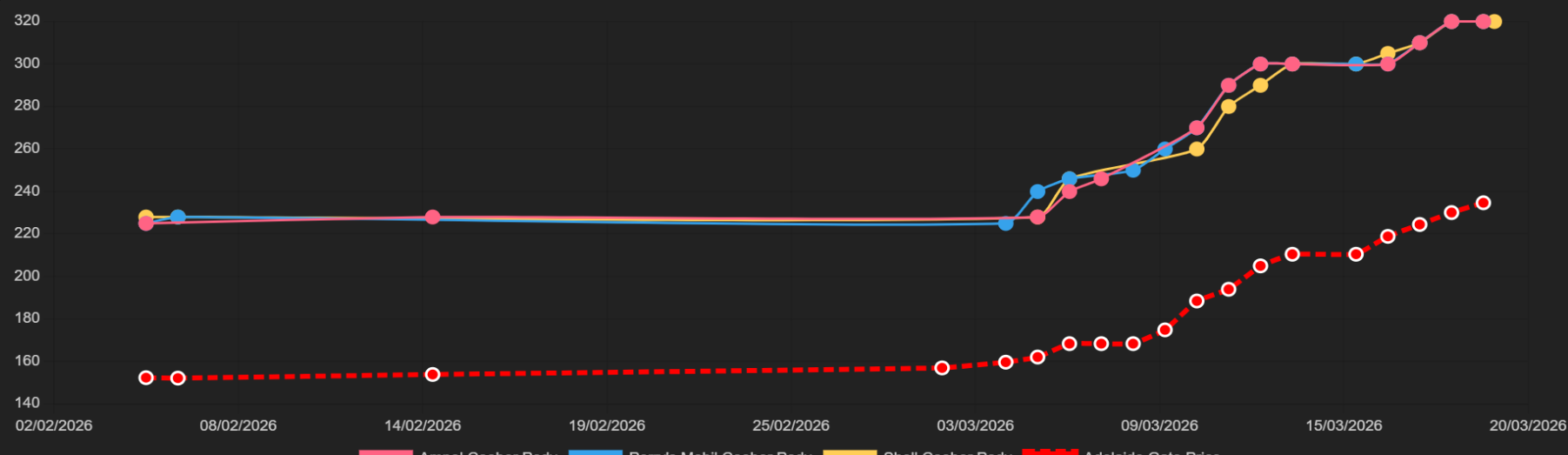
Recent figures comparing Adelaide’s wholesale “gate” prices with Coober Pedy’s retail bowser prices reveal a gap that is difficult to justify.
A Growing Price Divide
In mid-February, the average diesel gate price in Adelaide sat at 153.8 cents per litre. At the same time, Coober Pedy motorists were paying 227.9 cents per litre at the bowser.
That’s a difference of 74.1 cents per litre — or roughly 48% higher than the wholesale price in Adelaide.
Fast forward to today, and the gap has widened even further.
• Adelaide gate price: 234.6 c/L
• Coober Pedy bowser price: 319.9 c/L
That’s now an 85.3 cent difference, equating to approximately 36% higher than the wholesale price.
While the percentage margin has slightly decreased due to rising wholesale costs, the actual dollar difference per litre has grown significantly — meaning locals are paying even more out of pocket.
Freight Costs Don’t Tell the Full Story
Transporting fuel to Coober Pedy — around 800 km from Adelaide — does add cost. Industry estimates suggest this typically ranges from:
• 3.5 to 11 cents per litre,
• with some claims reaching as high as 13 cents per litre.
Even if we take the highest estimate of 13 c/L, it still leaves a substantial unexplained margin:
• February gap after freight: ~61 cents per litre
• Current gap after freight: ~72 cents per litre
These figures raise a simple but important question:
Where is the rest of the margin going?
Lockstep Pricing Raises Eyebrows
Equally concerning is how fuel prices in Coober Pedy behave across different service stations.
Despite outlets sourcing fuel from different suppliers, prices across town appear to move in near-perfect unison. When one changes, the others follow — often immediately.
In a competitive market, price variation is expected. Differences in supply chains, contracts, and operating costs should naturally produce at least some spread in pricing.
Instead, Coober Pedy motorists are seeing what looks like synchronised pricing, where competition appears limited — if present at all.
The Cost to the Community
For a remote town where fuel is not a luxury but a necessity, these differences hit hard.
Higher fuel costs affect:
• Families, already managing the high cost of living
• Local businesses, facing increased operating expenses
• Tourism, where perception of high prices can deter visitors
• Freight and goods, compounding costs across the entire community
Every extra 10 cents per litre adds up quickly. At current margins, Coober Pedy residents are effectively paying hundreds of dollars more per year per vehicle than their metropolitan counterparts.
Time for Transparency
The data now paints a clear picture: while higher prices in remote areas are expected, the scale of the difference in Coober Pedy appears well beyond what freight and logistics alone can explain.
Combined with the apparent lack of price competition, it raises serious concerns about how fuel pricing is determined in the region.
Locals are now asking:
• Why are margins so high?
• Why do prices move together across different operators?
• And who is ensuring fairness for remote communities?
A Community Watching Closely
With fuel price tracking now bringing these trends into the open, the conversation is shifting.
What was once accepted as “just the cost of living remote” is now being questioned — backed by hard data.
And for Coober Pedy, that data tells a story that many believe deserves answers.
View Fuel Price Graph
Bush Telegraph Dispatch