
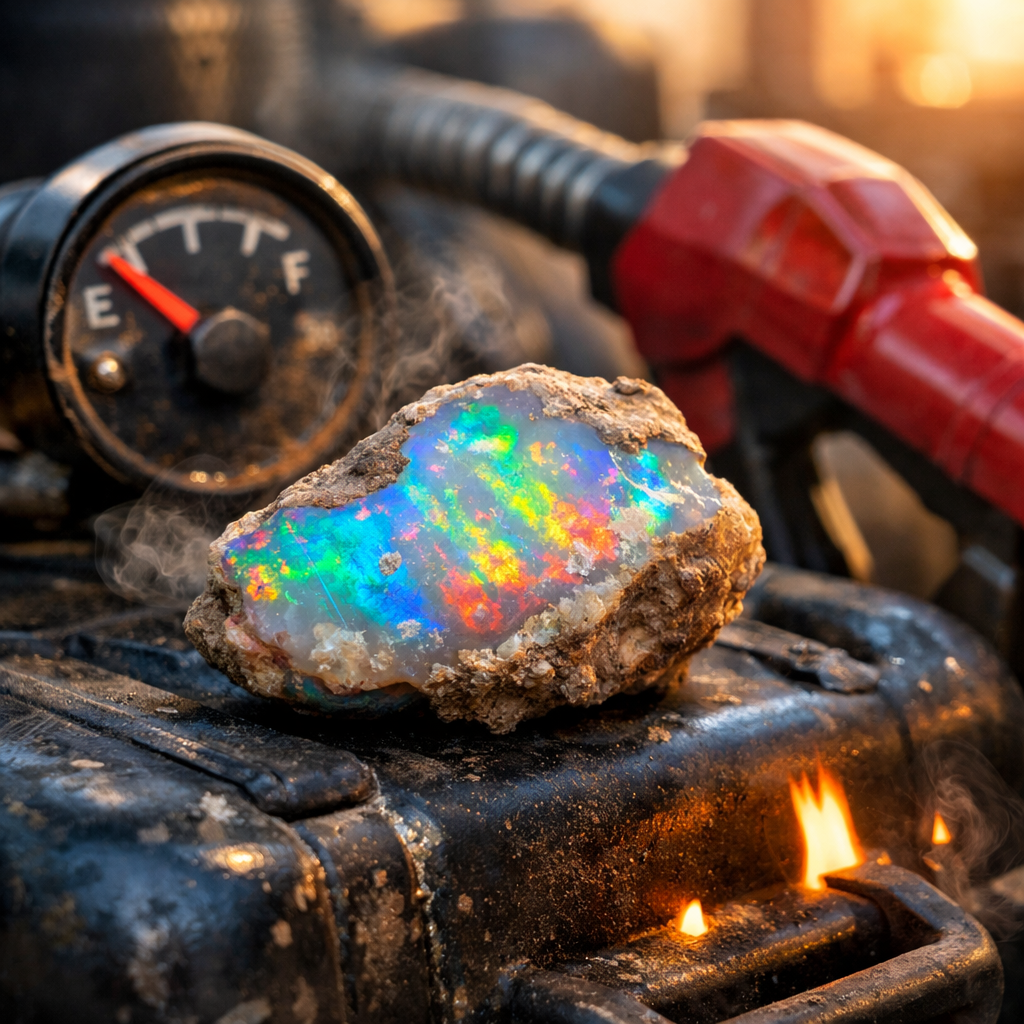
The global fuel crisis is beginning to ripple far beyond the bowser, with early signs emerging that the price of Australia’s national gemstone—opal—could be set for a sharp increase.
In the outback mining town of Coober Pedy, where the vast majority of the world’s precious opal is unearthed, miners are feeling the squeeze not from fuel shortages, but from the sheer cost of keeping their operations running.
Unlike many parts of the country, local residents did not engage in panic buying during recent supply concerns. Fuel has remained available. But availability has not insulated the industry from a dramatic surge in price.
Diesel at local pumps has climbed from approximately $2.20 per litre to as high as $3.49 in just over a fortnight. That represents an increase of more than 63 percent, a jump that is now directly impacting the cost of extracting opal from the ground.
For an industry already defined by high risk and high expense, the increase is significant. Large-scale opal mining operations can consume anywhere between 400 and 800 litres of diesel per day. At current prices, that translates to hundreds of additional dollars in daily operating costs, turning already marginal digs into financially unsustainable ventures.
Miners say the result is immediate and visible. Some operations have already been scaled back, while others have been placed on hold entirely as operators wait to see if fuel prices stabilise. The cost per tonne of dirt shifted, already one of the highest in the resource sector, has surged to what many are calling unprecedented levels.
Beyond fuel costs, miners are now facing additional pressure from emerging shortages of urea, a critical component used in the production of ammonium nitrate. Ammonium nitrate remains one of the primary explosives used across opal fields to break through hard ground, making it an essential part of many larger-scale mining operations.
Supply constraints and rising input costs for urea are beginning to filter through the supply chain, creating uncertainty around both availability and pricing of explosives. For miners already grappling with record diesel prices, the prospect of restricted access to blasting materials presents a compounding challenge. Industry voices warn that if these shortages persist, some operations may be forced to further reduce activity or halt altogether, tightening opal supply even more at a time when production is already under strain.
The downstream effect is expected to be a tightening of supply. Opal is already among the rarest gemstones in the world, and any slowdown in production is likely to reduce availability even further. Industry observers suggest this could trigger a surge in prices as buyers compete for increasingly scarce material.
There are also warnings that the current conditions could spark a rush on existing stock. Dealers and collectors, aware of the rising cost pressures, may begin securing supply ahead of anticipated price increases.
Attention is now turning to the upcoming annual gem trade event in Coober Pedy, scheduled for April 4 and 5. The event is expected to draw buyers from across Australia and overseas, and may represent one of the last opportunities to purchase opal at what could soon be considered pre-crisis prices.
Buyers, collectors and hobbyists are being urged to act early. If fuel costs remain elevated, or climb further, the cost of bringing new opal to market could rise to the point where supply becomes not just limited, but increasingly unattainable for all but the highest-end buyers.
In a town built on the promise of striking it rich beneath the desert, it is now the cost of reaching that promise that may reshape the market for Australia's most iconic gemstone.
Bush Telegraph Dispatch