
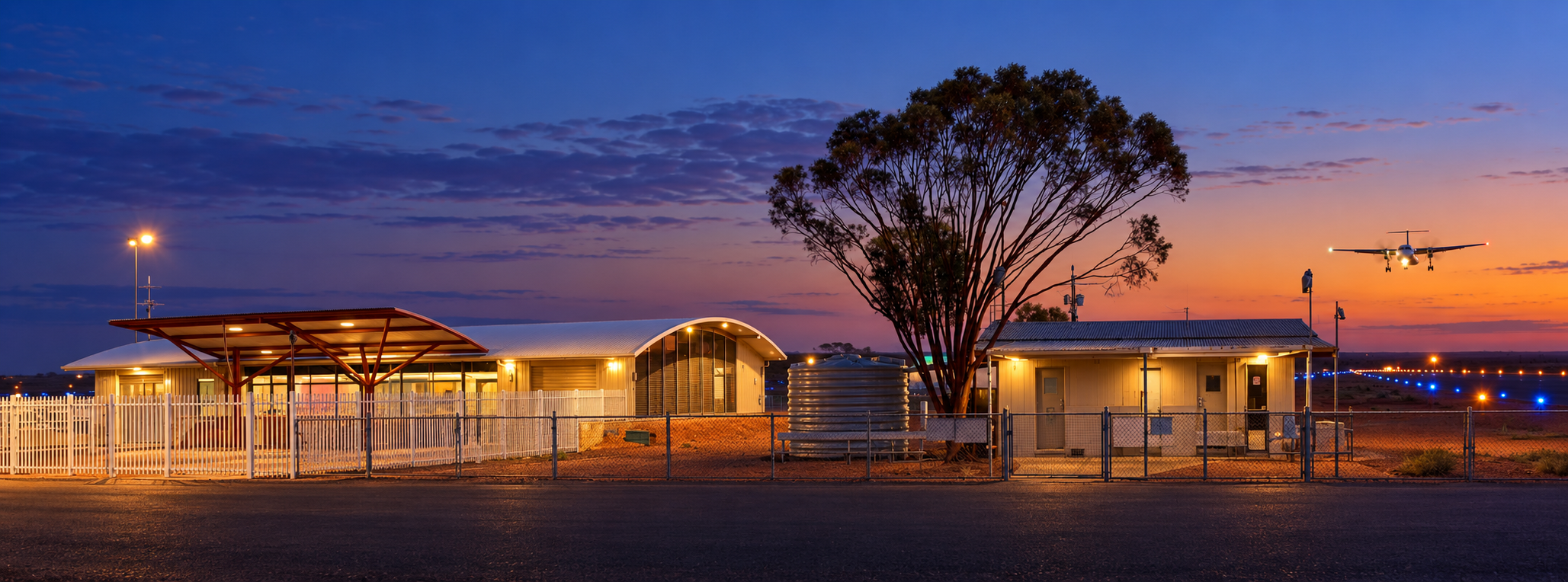
The District Council of Coober Pedy has secured $71,500 in State Government funding to replace the ageing lighting-control system at Coober Pedy Airport.
The funding forms part of almost $250,000 awarded to five regional airports and aerodromes through the latest round of the South Australian Supporting Regional Aviation Program.
According to the State Government announcement, replacing Coober Pedy’s ageing lighting-control system will improve safety and operational reliability while helping to preserve night-time and low-visibility access for the Royal Flying Doctor Service, emergency services and regular passenger flights.
For a remote community more than 800 kilometres from Adelaide, reliable airport lighting is not a luxury.
It can be the difference between an aircraft landing after dark and a medical evacuation being delayed. It also supports scheduled passenger services, government operations, mining activity, tourism and the many charter aircraft that connect Coober Pedy with the rest of the country.
The grant should therefore be welcomed as an important and practical investment in the town.
However, it should also be recognised for what it is: the replacement of one ageing airport system, rather than the comprehensive airport upgrade Coober Pedy will eventually require.
A HISTORY OF RUNWAY CONCERNS
Concerns about the airport’s infrastructure are not new.
In 2014, Coober Pedy faced the possible loss of its Rex passenger service because the sealed runway was only 18 metres wide and did not meet the standard required for the airline’s Saab 340 aircraft.
At the time, it was estimated that approximately $720,000 would be required to widen the runway. A $1.3 million project was subsequently supported by the South Australian Government, allowing the sealed runway to be widened to 30 metres and preserving the town’s regular passenger service.
That investment was extremely important—but it was made more than a decade ago to meet the requirements of the aircraft serving Coober Pedy at that time.
The aviation industry is changing. Regional airlines are operating under increasing financial pressure, older aircraft fleets will not remain in service forever, and replacement aircraft may be larger, heavier or have different pavement requirements.
A runway can be wide enough for an aircraft while still lacking the pavement strength, length or supporting infrastructure needed to accommodate it at normal operating weight.
That leaves Coober Pedy with an important long-term question: will the airport be capable of accepting the aircraft regional operators are likely to use in the future?
MORE THAN PASSENGER FLIGHTS
The airport’s value cannot be measured only by passenger numbers or ticket sales.
It provides critical access for the Royal Flying Doctor Service and other emergency operations. It supports the tourism industry, local businesses, government services, mining exploration and potential future investment across the Far North.
It is also an essential alternative connection when road access is disrupted by flooding, accidents or other emergencies.
Allowing the airport’s infrastructure to fall behind changing aviation requirements could therefore have consequences well beyond the loss of convenient passenger flights.
The new lighting-control system will reduce one immediate risk, but broader questions remain about the condition and strength of the runway pavement, taxiways, apron, airfield lighting, terminal facilities and other ageing infrastructure.
A WELCOME FIRST STEP
The $71,500 grant is a welcome result and Council should be congratulated for securing it.
It is also an opportunity to begin a more transparent discussion about the airport’s future.
The community should be told what further work has been identified, whether the runway has recently undergone a detailed pavement-strength and condition assessment, what aircraft it can currently accommodate, and what upgrades would be required to accept heavier aircraft in the future.
Council should also publish—or update—a long-term airport master plan setting out the work required, its estimated cost and the State and Federal funding programs that could help deliver it.
Funding opportunities are currently available through programs including the South Australian Supporting Regional Aviation Program and the Australian Government’s Regional Airports and Remote Airstrip Upgrade programs. Coober Pedy should be positioning itself now for further investment rather than waiting until ageing infrastructure threatens an essential service.
Replacing the lighting-control system is a worthwhile and necessary improvement.
But for a town as isolated as Coober Pedy, the airport is too important to be maintained through isolated grants and emergency repairs alone.
This funding should be welcomed as the beginning of a broader airport renewal program—not regarded as the job being finished.
Bush Telegraph Dispatch