
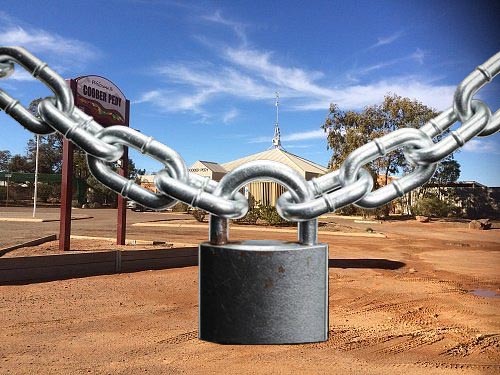
After nearly eight years of administration, Coober Pedy is being offered appointed guidance instead of an election. Before accepting that model, the town should examine the record of those proposed to guide it.
Coober Pedy was promised a council election in April 2027.
That election is now set to be cancelled. The State Government has introduced legislation that would allow the town’s administration to continue without a new fixed ending date while opening the way for a so-called “hybrid” council containing some combination of elected and government-appointed members.
Local Government Minister Rhiannon Pearce says Principal Administrator Patrick Conlon advised her “in the strongest possible terms” that the council was not ready to return to an elected body because of the seriousness and complexity of the problems still being addressed.
The Minister also says community leaders expressed a strong desire for a staged transition back to elected government.
The Government has not publicly said that nobody in Coober Pedy is qualified to serve on council. Nevertheless, the message received by many residents is difficult to distinguish from that conclusion: the town cannot yet be trusted to elect and govern through its own representatives without appointed people remaining in the room to supervise them.
That raises an obvious question.
After nearly eight years of administration, who exactly is qualified to teach whom?
The argument over who speaks for Coober Pedy
Coober Pedy Together and others have promoted the concept of a hybrid or staged governance model. They are entitled to advocate for that position, just as every resident and community organisation is entitled to participate in the debate.
The problem is not that they have an opinion.
The problem arises when the opinions expressed by selected organisations or “community leaders” are presented as the view of the broader Coober Pedy community without evidence of a town-wide vote, properly conducted survey or open consultation process.
Coober Pedy Together describes itself as a resident-led organisation. It is still not the elected voice of Coober Pedy. Neither is the Retail, Business and Tourism Association, an Aboriginal corporation, a government-appointed administrator or any other individual organisation.
Each may speak for its members and present its own position. None can automatically claim to speak for the town.
But even that debate risks distracting us from the much larger elephant standing in the council chamber.
What would a hybrid council actually achieve—and who would be doing the mentoring?
Nearly eight years to prepare—and no preparation
If the Government believes Coober Pedy lacks sufficient local experience to immediately operate an elected council, that concern cannot simply be dismissed.
Council members must understand budgets, infrastructure, conflicts of interest, procurement, governance and their legal obligations. Coober Pedy’s history demonstrates the damage that can occur when major decisions are made without adequate scrutiny.
But administration began in January 2019.
Where, during the years that followed, was the structured program to identify and prepare future councillors?
Where were the publicly advertised governance courses, council-finance workshops, candidate information sessions, mentoring programs and opportunities for residents to sit alongside administrators and learn how decisions were made?
Where is the succession plan?
An administration genuinely preparing a community to resume democratic government would have been developing that capacity from the beginning. Potential representatives should by now have years of exposure to council budgets, strategic planning, asset management and governance.
Instead, Coober Pedy has repeatedly been told that it is not ready while receiving little visible assistance to become ready.
Administration cannot justify its own continuation by pointing to a lack of local preparedness that it has had nearly eight years to address.
Follow the liabilities
The financial record makes the proposed mentoring arrangement even harder to accept.
The last audited financial year ending before administration showed that, at 30 June 2018, Coober Pedy Council had total liabilities of $11.931 million.
By 30 June 2019—approximately five months after administration began—total liabilities had risen to $14.871 million.
At 30 June 2025, Council reported total liabilities of $103.068 million.
That final figure requires an important explanation. Approximately $88.098 million relates to the accounting recognition of Council’s long-term electricity-generation lease. It would therefore be misleading to suggest administrators simply borrowed another $88 million and spent it.
But removing that electricity lease does not produce a success story.
Excluding the lease liability leaves approximately $14.97 million in other liabilities—around $3 million more than the last audited year-end before administration and almost exactly where total liabilities stood after the administrators’ first five months.
The individual figures are equally revealing.
Ordinary council loans stood at approximately $7.91 million in June 2019. Today, Council says it owes $7.7 million to the Local Government Finance Authority.
That is a reduction of only about $210,000 across more than seven years.
Trade and other payables were $6.289 million in 2019. In 2025, they were $6.294 million—effectively unchanged.
Council has itself acknowledged that, apart from one $100,000 payment, it has not had the money to make meaningful repayments on its LGFA borrowings. The loans continue to be rolled over while Council pays interest.
Accountants may distinguish between loans, lease liabilities, creditors and provisions. Ratepayers understand the more practical reality: liabilities are financial obligations that Council must eventually meet.
The headline total has blown out because of the electricity-lease accounting treatment. Even after removing that factor, the underlying position has not materially improved.
After nearly eight years of administration, the debt has not been solved. Major creditor balances remain. Infrastructure has continued to deteriorate. Council is still described as financially unsustainable, and the Government now cites those unresolved problems as a reason residents cannot vote.
That is not financial recovery.
At best, it is containment.
Patrick Conlon deserves some recognition
It is fair to acknowledge that the latest Principal Administrator, Patrick Conlon, appears to have made some small but measurable forward moves after years of drift.
The proposed transfer of water services to SA Water is progressing. Discussions about the future of electricity delivery are underway. Debt management is being confronted openly as a central issue rather than being buried beneath optimistic language.
Mr Conlon has also indicated that progress on water and debt means an end to administration should not be too far into 2027.
Those developments matter. Resolving the water and electricity burdens could leave Coober Pedy with a smaller, more conventional municipal council and remove risks that a community of approximately 1,600 people should arguably never have been expected to carry alone.
Mr Conlon should receive credit where progress is real.
But he arrived late in a process that had already consumed most of a decade. Small steps in the right direction cannot erase the record of the administration as a whole, nor can they justify replacing a promised election with an open-ended arrangement.
The question must be asked: is this progress sufficient to justify more unelected government, or is it too little and too late?
The blind leading the blind
The proposed hybrid model appears to rest on the idea that elected local members would be mentored, guided or restrained by experienced appointed members.
On paper, that can sound sensible.
In practice, it contains a glaring contradiction.
The administration proposed as the source of guidance has not solved the financial problems it inherited. It has not substantially reduced the loan balance. It has not cleared major creditor obligations. It has not restored financial sustainability. It has not kept pace with infrastructure renewal. Most importantly, it has not spent the past eight years visibly preparing the community to resume control.
What lessons will appointed members impart?
How to roll over the same loans for another year?
How to oversee liabilities that remain virtually unchanged beneath the electricity-lease accounting entry?
How to tell the community it is not ready while offering no measurable definition of readiness?
How to continue administration until an unspecified future date?
Mentoring has value when the mentor can demonstrate success. Experience alone is not the same as achievement.
A hybrid council risks becoming the blind leading the supposedly blind—with the appointed members retaining authority because the elected members are declared inexperienced, while the appointed system’s own record remains largely unexamined.
If hybrid is the answer, show us the safeguards
A transitional hybrid arrangement could be defensible, but only if it is genuinely transitional.
Without safeguards, “hybrid” may simply become a softer name for continuing administration.
Coober Pedy could be permitted to elect representatives while real power remains with appointees. The town might technically leave administration without regaining meaningful democratic control.
That is not a transition. It is administration wearing a different hat.
The question the Government must answer
Nobody is arguing that the former elected council made no mistakes. Those failures were the reason administration began.
But the failures of 2016 cannot remain the permanent answer to every question asked in 2026.
The relevant issue now is the performance of administration.
It inherited total liabilities of approximately $11.9 million at the last financial year-end before its appointment. Nearly eight years later, the underlying liabilities have not been brought under control in any meaningful way, ordinary loan debt has barely moved, major creditor obligations remain and the town has not been adequately prepared to resume democratic government.
Yet this same system may now be asked to mentor the people chosen by the community.
Before accepting that model, Coober Pedy deserves an explanation of what the appointed administration has achieved, what it has failed to achieve and why its representatives are presumed better qualified to guide the town than the residents who live with the consequences of their decisions.
A hybrid council may have a role as a short, tightly controlled bridge back to democracy.
It must not become another merry-go-round with no destination, no timetable and the same people holding the controls.
After nearly eight years, Coober Pedy does not need another promise that it will be ready one day.
It needs a plan, a deadline and its democratic voice returned.
Bush Telegraph Dispatch