
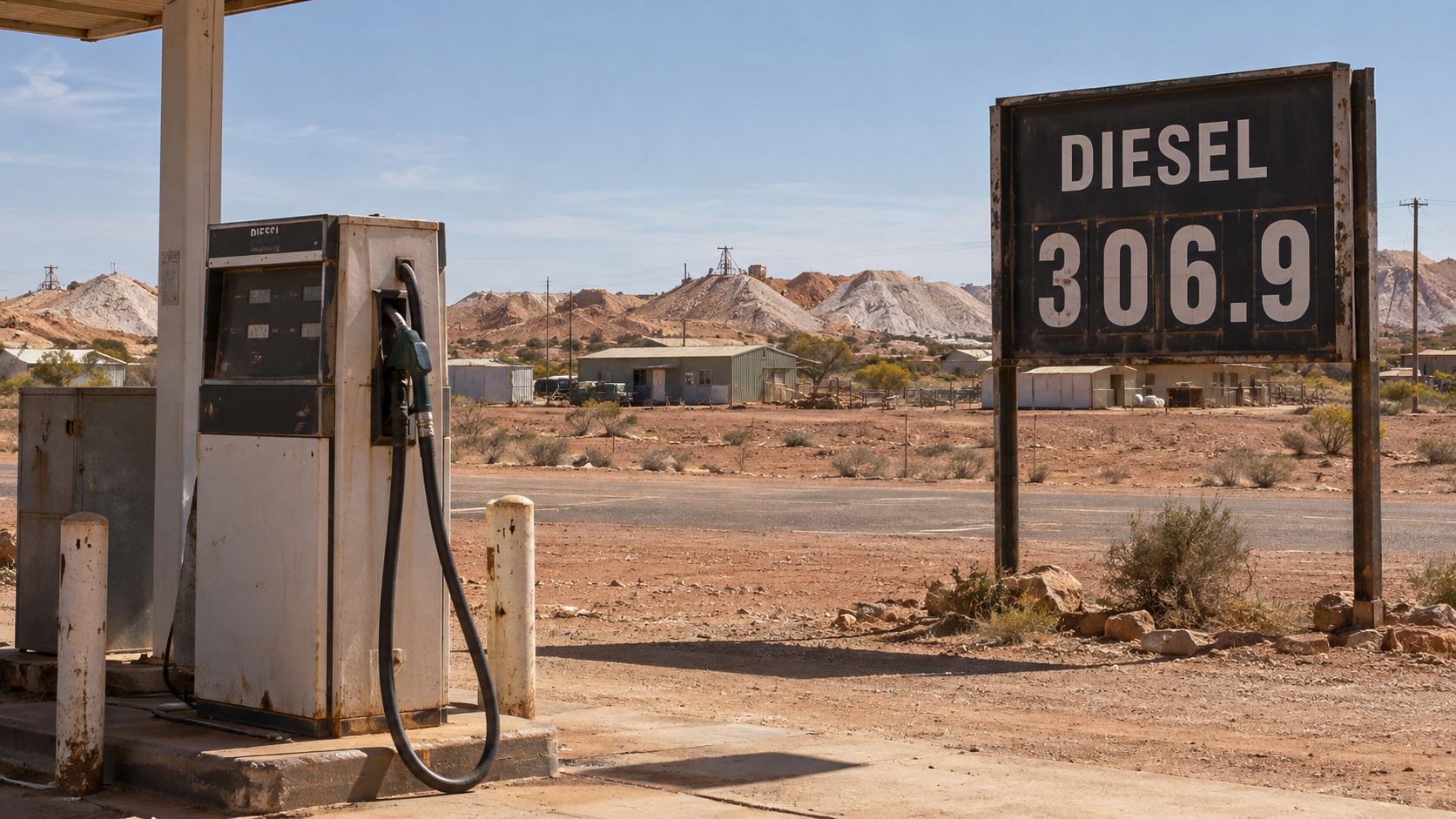
At one point the gap between Adelaide’s gate price and a Coober Pedy bowser reached $1.34 a litre. Freight may explain around 13 cents. So where did the rest go?
There is paying extra because you live remotely—and then there is what has been happening in Coober Pedy.
On 23 April, diesel was selling for 359.9 cents per litre at Perry’s Mobil, Ampol and Shell. All three stations. Exactly the same price.
The Adelaide terminal-gate price that day was 230.2 cents.
That left a difference of 129.7 cents on every litre before it reached the tank of a Coober Pedy motorist.
The next morning, the gate price fell again. At one recorded update, Shell remained at 359.9 cents while the Adelaide gate price had dropped to 225.7 cents—a staggering 134.2-cent disparity. Perry’s Mobil and Ampol were charging 349.9 cents, still 124.2 cents above gate.
Published industry estimates examined previously by The Bush Telegraph put the cost of transporting fuel to remote locations at roughly 3.5 to 11 cents per litre, with some estimates reaching 13 cents.
Give the retailers the entire 13 cents. Be generous.
It still leaves more than $1.07 to $1.21 on every litre to be explained through storage, wages, card fees, operating costs and profit.
On a 100-litre fill, that unexplained difference represents more than $100. For a mine, farm, earthmoving business or road transport operator buying thousands of litres, it becomes crippling.
This is not a theoretical argument about oil markets. It is money being removed from the pockets of one of Australia’s most isolated communities—one litre at a time.
And the figures come from the prices themselves.
Different signs, same price
Coober Pedy’s fuel database contains 15,299 observations collected between 5 February and 18 September 2026. Prices are checked every 30 minutes.
The records show that the three main stations do not merely end up close together. They repeatedly arrive at the identical tenth of a cent, sometimes within the same monitoring window.
On 24 March, Perry’s Mobil, Ampol and Shell were all first recorded at 349.9 cents in the same 6.01 pm update.
On 4 May, all three changed in the same update. On 5 May, all three appeared at 299.9 cents in the same 7.17 am update. On 24 June, all three were recorded at 249.9 cents together.
Because the system checks every half-hour, those changes occurred no more than 30 minutes apart. Evidence on the ground suggests some changes were faster.
Nobody needs to allege a secret telephone call to recognise the problem. Australian competition law permits one retailer to observe another’s public price and match it independently. Parallel pricing is not automatically unlawful.
But legality is not the only question.
If three supposedly competing stations repeatedly charge exactly the same price, change to exactly the same price and sometimes do it within the same 30-minute window, what competition is the customer actually receiving?
A different logo above the same number is not meaningful competition.
Prices rise like rockets—and fall like feathers
April is where the claim that “it is just freight” collapses.
The three main stations reached 359.9 cents while Adelaide wholesale prices were climbing. But when wholesale prices began falling, the bowsers remained stubbornly high.
On 22 April, all three were charging 359.9 cents against a gate price of 239.3 cents—a 120.6-cent gap.
On 23 April, all three remained at 359.9 cents while gate fell to 230.2 cents. The gap widened to 129.7 cents without the stations lifting their price by a single cent.
On 25 April, all three were at 349.9 cents while gate sat at 225.7 cents—a 124.2-cent difference. On 28 April, all three remained at 349.9 cents against 224.8 cents—a gap of 125.1 cents.
The disparity stayed above $1.20 a litre across repeated observations into early May.
That is the question the fuel retailers must answer: when their underlying benchmark was falling, why was Coober Pedy still being charged as though it had not?
Retailers may argue that fuel already stored underground was purchased at an earlier, higher price. That can explain a delay. It cannot be used indefinitely—particularly when fuel deliveries have occurred and when prices are capable of moving upward within hours of a changing market.
If old expensive stock delays a price fall, the public is entitled to ask whether old cheaper stock ever delays a price rise by the same amount.
The latest rise does not erase April
Today, Perry’s Mobil, Ampol and Shell are listed at 306.9 cents. Perry’s unmanned outlet is one cent cheaper at 305.9 cents.
The latest Adelaide gate price in the database is 263.8 cents, leaving a current difference of about 43 cents per litre.
That is far below April’s obscene $1.20-plus disparities, but it is still more than three times the upper-end 13-cent freight estimate before other costs are considered.
It is also true that the latest wholesale increase has been severe. Adelaide’s gate price rose from 152.3 cents on 5 February to 263.8 cents on 18 September—an increase of 111.5 cents. Over the same period, Perry’s Mobil rose from 224.9 to 306.9 cents, an increase of 82 cents.
The war-driven wholesale surge is real. But acknowledging that does not absolve what happened when the market moved in the other direction.
Both things can be true: international supply shocks can force prices upward, and retailers can still retain unjustifiably large disparities when wholesale prices fall.
The public should not be asked to forget the second fact whenever the first becomes convenient.
Crude oil is not the whole bill—but history still exposes the disconnect
Fuel companies and governments routinely point to war and the world oil price. It is an explanation Australians have heard for years.
Yet the bowser does not consistently follow crude oil in a neat line.
In March 2022, after Russia invaded Ukraine, Brent crude averaged approximately US$118 a barrel. Australia’s automotive-fuel price index reached 110.04.
By September 2023, Brent was lower—around US$94—yet the Australian fuel-price index was higher at 113.17.
In March 2026, the fuel index surged to 125.29, its highest point in the ABS series shown, after a 32.8 per cent increase in one month. It was 10.7 per cent above the previous September 2023 peak.
Coober Pedy’s database tells a similar story. Brent averaged about US$69.62 in February 2026, approximately US$100 in March and US$102 in April. Yet local diesel reached 359.9 cents. Brent later retreated to around US$84 in June and July, but the relief reaching the bowser was slower and incomplete.
The reason is that Australia does not price diesel from crude alone. Our market is tied to the Asian price of finished diesel—Singapore Gasoil—along with the Australian dollar, refining margins, shipping, insurance, taxes, wholesale margins and retail margins.
That explanation matters. But it also moves the investigation further up the supply chain.
If crude oil is not responsible for the entire increase, who is collecting the difference between crude and refined diesel?
Follow the profits
The latest oil-company accounts make uncomfortable reading for anybody being told that everyone is simply suffering together.
Shell reported US$9.8 billion in adjusted earnings in the second quarter of 2026 and more than US$21 billion in operating cash flow. It announced another US$3 billion share buyback.
Shell also told investors that its refineries achieved 102 per cent utilisation during what it described as a “high-margin period.” It said production was shifted toward middle distillates—including diesel-related products—to capture more value.
BP reported US$5.7 billion in underlying replacement-cost profit for the same quarter, up from US$3.2 billion in the previous quarter and US$2.4 billion a year earlier. It generated US$10.9 billion in operating cash flow and increased its dividend. BP said significantly higher realised refining margins helped produce the result.
There it is in the companies’ own language: high margins, capturing value, and higher realised refining margins.
Those global profits do not prove how much an individual Coober Pedy station earns. Some branded outlets may be independently operated, and global earnings span drilling, refining, trading, gas and retail operations.
But the accounts destroy the suggestion that the industry is merely a helpless victim passing war costs down the line. Major energy companies are not simply surviving the volatility. They are monetising it—and returning billions to shareholders while Australian families and businesses absorb the price.
The war may be real. So are the profits.
Diesel drives the price of almost everything
The cost does not stop with the person holding the bowser nozzle.
Australia’s mines run on diesel. Farms plant and harvest with diesel. Trucks move food, medicine, building materials and almost every consumer product with diesel. Remote businesses generate power, operate machinery and serve tourists with diesel.
Every increase is carried into another invoice.
A supermarket does not absorb a transport surcharge forever. A farmer cannot repeatedly pay more to operate machinery without increasing prices. A freight company cannot lose money on every kilometre. Eventually, the public pays again—in food, construction, services and everything hauled by road.
The ABS gives automotive fuel a 3.5 per cent weight in the household inflation basket, but its real influence extends further because fuel is embedded in the cost of other goods and services.
This is why diesel should be treated as nationally significant economic infrastructure, not merely another retail product.
Australians are told inflation must be controlled through higher interest rates and household restraint. Yet one of the economy’s most important input costs is left to an opaque international and domestic supply chain capable of producing enormous corporate profits and, in Coober Pedy, price disparities exceeding a dollar per litre.
Households are told to spend less. Who is telling the fuel industry to take less?
Stop hiding behind “remote”
Coober Pedy accepts that freight costs money. Nobody expects a tanker to travel roughly 850 kilometres for free. Nobody expects a small remote outlet to operate on the same turnover or cost base as a metropolitan service station.
But “remote” is not a blank cheque.
If freight costs as much as 13 cents per litre, show it. If storage, wages, insurance and low sales volumes account for another large amount, show that too. If a station paid far above the published gate price, produce the invoice—with commercially sensitive details removed if necessary.
What should no longer be accepted is a vague reference to distance being used to explain a disparity that reached 134.2 cents per litre.
The numbers are now public. The burden of explanation belongs to the sellers.
Each supplier should be asked:
• What was the actual delivered wholesale cost of the fuel sold during the April disparities?
• How many cents per litre did freight add?
• What costs made up the remainder between Adelaide gate and the bowser?
• Who set the retail price—the local operator, distributor or corporate system?
• Why did competing stations repeatedly move to identical prices within the same 30-minute monitoring window?
• How quickly are wholesale increases passed on compared with wholesale decreases?
• What gross margin per litre was earned while the disparity exceeded $1.20?
The ACCC should be asking the same questions.
Coober Pedy is not angry because fuel costs more than Adelaide. People understand geography.
They are angry because they have watched three price boards move together, watched reductions stall, watched disparities blow beyond a dollar per litre and been offered no transparent explanation.
War can explain a rising international market. It cannot explain every cent charged at every bowser.
And until the industry accounts for those cents, “remote freight” will sound less like an explanation and more like an excuse.
Bush Telegraph Dispatch