
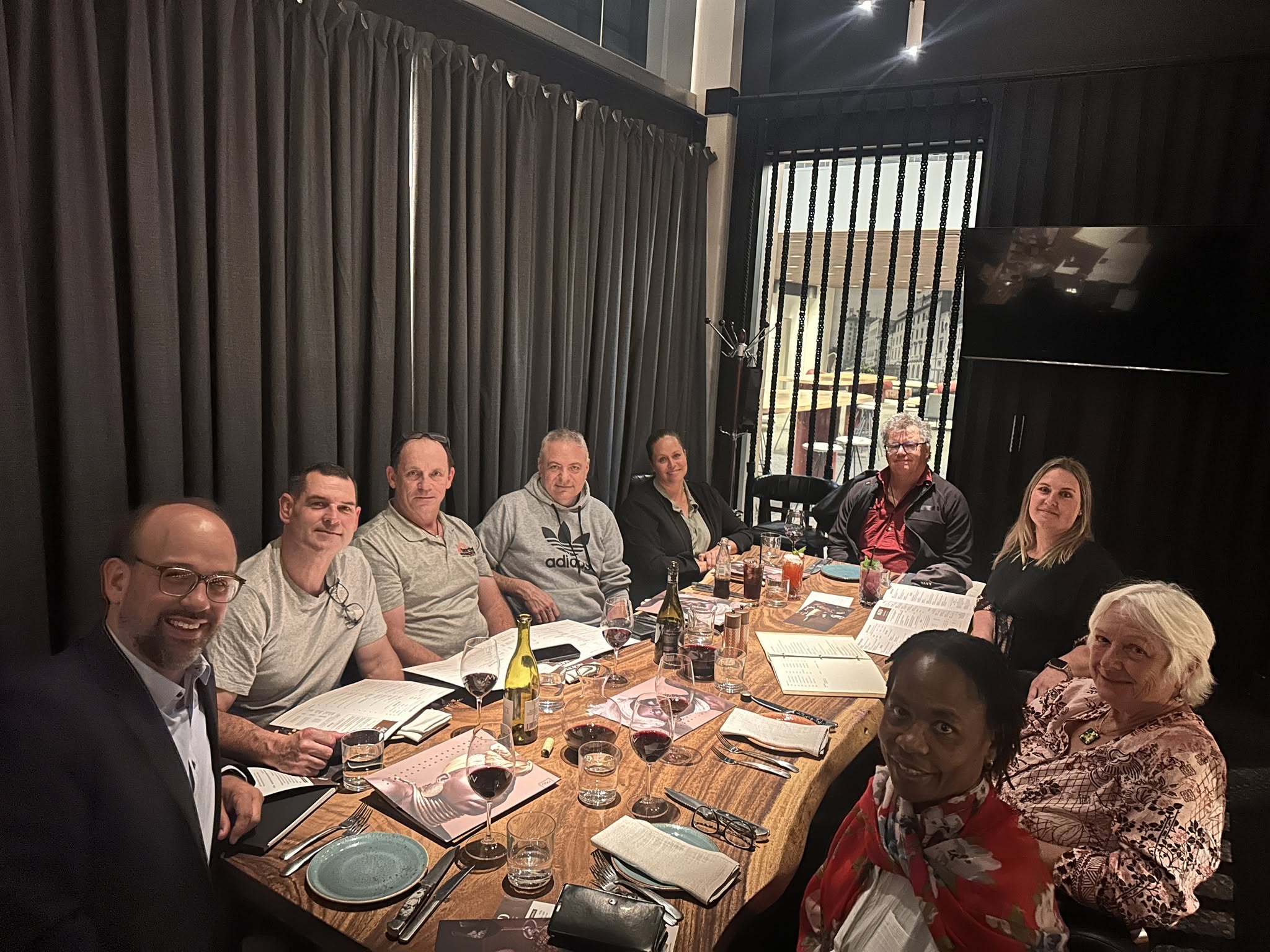
A delegation from Coober Pedy is spending this week in Adelaide, holding a series of meetings intended to strengthen the town’s standing as the recognised “Hub of Far North South Australia.”
Coober Pedy Together Incorporated—or CPT—has described the visit as an official delegation involving conversations with government ministers, opposition and minor-party representatives, mining companies, the Australian Army and other organisations.
It is an ambitious program and, viewed through the photographs being shared from Adelaide, an encouraging sight: Coober Pedy residents sitting in rooms with people who may be able to influence decisions affecting the town’s future.
The delegation began its week at Keswick Barracks, meeting representatives of the Australian Army’s 9th Brigade. According to CPT, discussions focused on establishing an ongoing relationship and exploring programs and opportunities for young people in Coober Pedy.
The group also met with the Police Association of South Australia to discuss the pressures facing local police and what officers may need to feel properly supported while keeping the community safe.
Further meetings reported by CPT have included Geoff Brock MP, Blair Boyer MP and Erin Thompson MP. Delegates also attended Question Time in Parliament and met with Peak Iron Mines, which CPT described as “a great friend of Coober Pedy.”
More meetings are reportedly scheduled with government, opposition and other stakeholders before the delegation returns home.
Affirming Coober Pedy as the northern hub
The central request being taken to Adelaide is not for Coober Pedy to become the Far North’s hub, but for government and other decision-makers to formally recognise the role CPT says the town already performs.
There is considerable merit in that argument.
Coober Pedy provides services to an enormous surrounding region. It has an airport, hospital, police station, school, emergency services, tourism infrastructure and long-established links to the pastoral, mining and Aboriginal communities of the Far North.
What formal recognition as a “hub” would mean in practice, however, has not yet been explained publicly.
Would it lead to additional health services, increased police resources, airport investment, improved education, new government offices or funding for regional infrastructure? Would recognition be embodied in government policy, a regional development strategy or a specific funding commitment?
A title alone would change very little. Recognition accompanied by defined responsibilities, resources and measurable commitments could be considerably more valuable.
CPT says it has developed a ten-point plan covering council governance, the airport, health and wellbeing, educational pathways, policing, emergency services, tourism, destination development and Coober Pedy’s position as the Opal Capital of the World.
That potentially makes the plan one of the more important documents currently being presented in the town’s name.
Publishing the complete ten-point plan would allow residents to understand exactly what is being requested, which priorities have been placed first and what commitments the delegation hopes to bring home.
It would also give the wider community an opportunity to support the proposals—and contribute knowledge that may strengthen them.
Who is representing Coober Pedy?
The photographs show a sizeable local delegation, but CPT has not publicly released a complete list of delegates, their roles within the incorporated association or the basis upon which they were selected.
That information would add useful context to the mission.
Coober Pedy is a diverse community containing tourism operators, retailers, miners, accommodation providers, Aboriginal organisations, cultural groups, sporting clubs, health workers, educators, emergency-service volunteers and residents with very different experiences of life in the town.
No delegation can include everyone. Nevertheless, when a group speaks to ministers and major organisations on behalf of a community, it is reasonable for residents to know who is speaking, what interests and sectors are represented, and how the delegation established its mandate.
CPT says its priorities emerged from “many many conversations” with local people. Explaining how those conversations were conducted—and approximately how many residents, organisations and businesses participated—would help demonstrate the depth of community support behind the ten-point plan.
It would be particularly valuable to know whether any public survey, open forum, written submission process or independently recorded consultation contributed to the final document.
From meetings to outcomes
This is not the first time representatives associated with CPT have travelled to Adelaide or held high-level meetings concerning Coober Pedy.
Previous visits have produced photographs, conversations and optimistic public updates. What has been more difficult for residents to identify is the direct line between those meetings and lasting outcomes on the ground.
That does not necessarily mean the discussions achieved nothing. Advocacy often takes time, relationships may develop quietly and government decisions rarely happen after a single meeting.
But after several years of representation, the community would benefit from a straightforward account of what earlier delegations requested, what responses they received and which outcomes can now be attributed to that work.
The same standard should apply to the present visit.
At the conclusion of the week, success could be reported through more than the number of meetings attended. The most useful update would identify:
▪️ The specific requests presented to each organisation.
▪️ Any commitments, undertakings or follow-up actions received.
▪️ The people or agencies responsible for those actions.
▪️ Expected timeframes.
▪️ How progress will be reported to the community.
▪️ Any request that was declined or remains unresolved.
Not every meeting will produce an immediate announcement, but documenting the next step would allow residents to follow the process and help maintain momentum after the photographs have been posted.
Independence brings new questions
This visit also comes during a new chapter for Coober Pedy Together.
Council funding of the former facilitator arrangement has ended, while CPT now operates as an independent incorporated association. The organisation has indicated that grants or external support will enable its work to continue.
Independence may give CPT greater freedom to pursue projects and relationships beyond council. It also makes transparency about funding, governance and representation particularly important.
Residents do not necessarily need private financial information. They should, however, be able to understand whether the delegation is self-funded, grant-funded, sponsored or supported in kind—and whether any organisation contributing to the trip has an interest in matters included in the ten-point plan.
That is ordinary transparency for an incorporated body representing community interests. It protects the delegation as much as it informs the public, preventing rumours from filling gaps that could be resolved with a simple explanation.
An opportunity to bring the community along
There is value in Coober Pedy having people prepared to travel, arrange meetings and place the town’s needs before decision-makers.
The challenge is ensuring that representation remains connected to the people being represented.
CPT has promised daily information about its conversations and outcomes. That commitment creates an opportunity to establish a new level of openness: publish the delegation, release the ten-point plan, explain how it was developed, identify the support behind the trip and report the results in measurable terms.
If Adelaide formally recognises Coober Pedy as the Hub of Far North South Australia—and backs that recognition with services, infrastructure and resources—the delegation will have achieved something the whole town can welcome.
Until then, the photographs tell us that conversations are taking place.
The important story will be what comes home with them.
Bush Telegraph Dispatch