
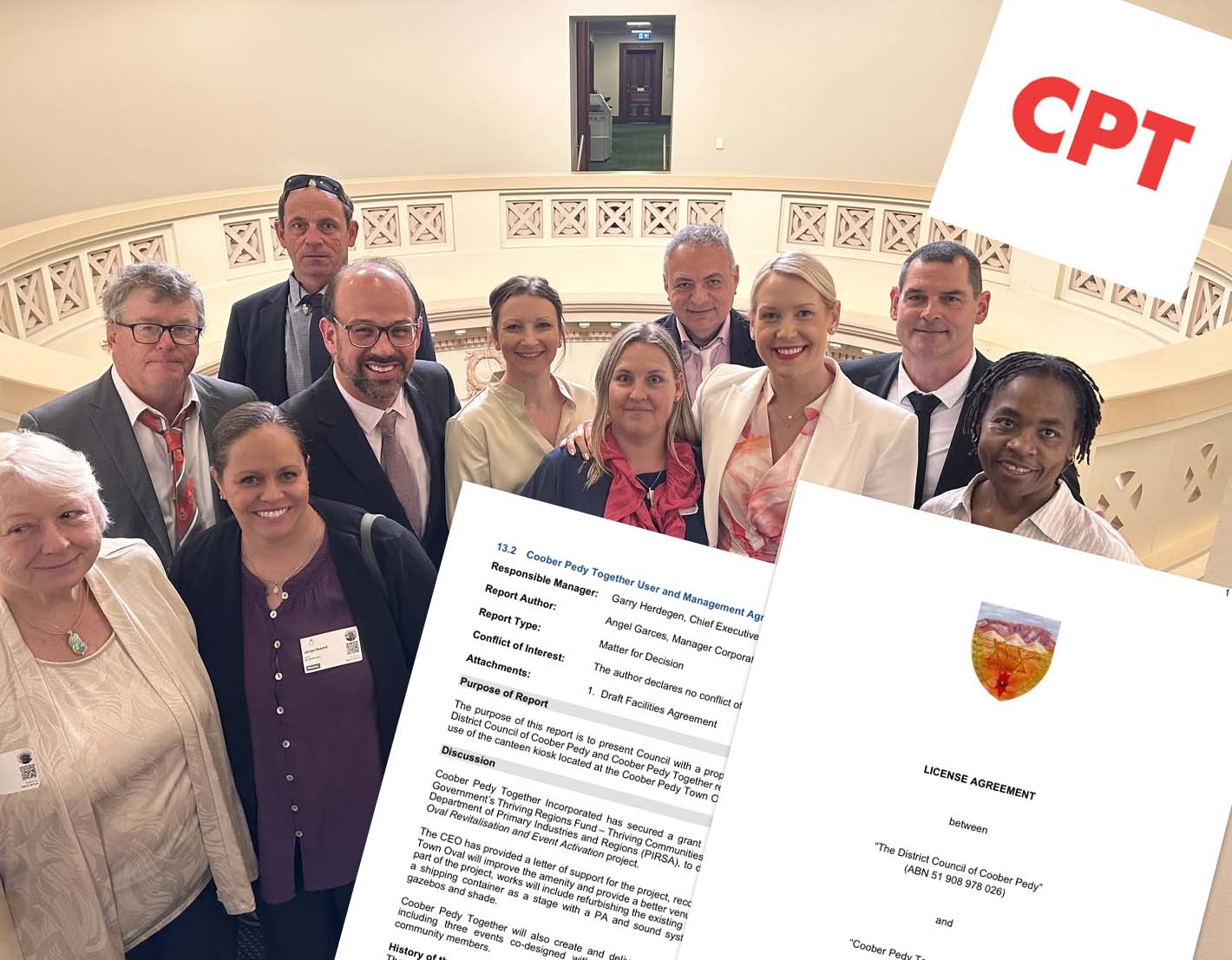
A draft Council agreement would give Coober Pedy Together exclusive use of the publicly owned canteen kiosk—but not exclusive control of the Oval itself
Coober Pedy Together Incorporated could receive exclusive use of the Town Oval canteen for five years under a draft agreement published by the District Council of Coober Pedy.
The proposed licence fee is just $1 “upon demand.”
The arrangement forms part of CPT’s separately funded $49,680 Town Oval Revitalisation and Event Activation project, supported through the South Australian Government’s Thriving Communities Program.
That grant is additional to the $29,323 recently awarded to CPT by the Department of Human Services for its “Growing Volunteer Leaders for Community Action” project. Together, the two State Government grants provide CPT with $79,003 in public funding.
What does the five-year licence cover?
The wording of the draft agreement is important.
It does not give CPT exclusive possession or control of the entire Town Oval for five years.
The premises covered by the five-year licence are specifically identified as the Coober Pedy canteen kiosk.
The permitted uses are:
1. Exclusive use of the Coober Pedy canteen kiosk; and
2. Non-exclusive use of the Coober Pedy Town Oval.
In practical terms, CPT would control the canteen and manage its bookings throughout the five-year term. Its right to use the wider Oval would be shared rather than exclusive.
Council’s report says CPT would be responsible for “managing all bookings throughout the term of the agreement” and making the canteen facility available for community use.
That distinction matters—but it does not remove the central question: why should one incorporated organisation receive exclusive control over a community facility for five years at a nominal fee?
The $1 arrangement
The draft identifies the licence fee simply as:
“$1 upon demand.”
It does not say $1 per year. On the published wording, it appears to be a nominal or “peppercorn” payment applying to the licence as a whole, although the final agreement should clarify this.
Council’s report states there are “no direct financial implications” arising from the proposal.
However, that description does not address the potential value of five years’ exclusive access to a publicly owned facility, the ability to control its bookings, or whether other community organisations were given an opportunity to express interest.
A nominal fee is not automatically improper. Councils regularly allow sporting clubs and community organisations to use facilities at heavily reduced rates when those groups maintain the property and provide a genuine public benefit.
But such arrangements should still be transparent, consistently applied and supported by clear conditions governing access, bookings, charges, revenue and accountability.
What CPT would be required to pay
The $1 licence does not mean CPT would carry no responsibilities.
Under the draft, CPT would be required to:
• Pay all outgoings connected with the premises.
• Keep the canteen clean, maintained and in good repair.
• Meet the cost of maintenance for which it is responsible.
• Hold at least $20 million in public-liability insurance.
• Insure its own equipment and contents.
• Obtain Council approval before making permanent alterations.
• Return the premises in good order when the licence ends.
Council would continue insuring the building itself.
Unless Council agreed otherwise in writing, structures, improvements, fixtures and fittings placed in or on the licensed premises during the licence period would ultimately become Council property.
These obligations provide some public protection, but they do not explain how bookings would operate or whether CPT could charge other organisations to use the canteen.
What will the $49,680 grant deliver?
Council records say the State-funded project includes:
• Refurbishing the existing Town Oval canteen.
• Fitting out a shipping container as a stage.
• Installing a PA and sound system.
• Providing additional gazebos and shade.
• Delivering three community-led events at the Oval.
The official PIRSA grant disclosure confirms CPT received $49,680 for the project.
The grant therefore funds improvements to facilities situated on Council-controlled community land. That makes the proposed five-year exclusive canteen licence more significant than an ordinary room-hire arrangement.
Public money would improve the facility, CPT would manage it, and CPT would receive exclusive use of the canteen for a nominal licence fee.
The agreement is not yet final
The published document remains a draft.
At its meeting on 26 August 2026, Council did not approve the licence in its final form. Instead, it authorised the Chief Executive Officer to hold further discussions with CPT and required the completed agreement to return to Council for consideration.
The resolution also required the eventual report to address matters raised by the Coober Pedy Community Alliance in an email dated 26 August.
Council’s September status report continued to list the matter as “In Progress,” with a meeting between CPT and Council still to be organised.
There is therefore no public evidence yet that CPT has obtained an executed five-year licence.
Read the Council report and draft agreement.
Pages 20-35
Questions that should be answered before approval
Before any five-year agreement is signed, Council should publicly explain:
• Why was CPT selected to manage the canteen?
• Was the opportunity offered to other community, sporting or event organisations?
• Is the $1 fee a single payment or an annual fee?
• Who will set booking conditions and decide which groups receive access?
• Will CPT be permitted to charge hire fees or retain revenue?
• Will a public booking register and fee schedule be published?
• Can Council require access for major community events?
• What performance standards must CPT meet?
• Can the agreement be ended if community access becomes unreasonable?
• How will the $49,680 grant expenditure be reported and acquitted?
• Do any grant funds cover wages, facilitation or consultancy payments?
The draft allows Council to terminate the licence if CPT fails to meet its obligations, but it contains no clearly published community-access standard, booking policy or public reporting requirement.
Community facility or organisational asset?
The canteen was originally purchased by the Coober Pedy Football Club in 2010 and proposed for transfer to Council as a community-owned asset.
Council says it has since been recognised and managed as a Council asset.
That history makes the present proposal worthy of careful scrutiny. A facility created for community use should not quietly become the effective domain of one organisation without clear safeguards ensuring fair and affordable access for everyone.
CPT may ultimately manage the facility responsibly and use the State grant to deliver worthwhile improvements. The project itself may provide genuine benefit.
But a five-year exclusive licence over a public facility—particularly for a nominal $1 fee—should be supported by more than good intentions.
The final agreement, booking rules, charges, revenue arrangements and public-access guarantees should all be released before Council makes its decision.
Bush Telegraph Dispatch